Industrial Cabinet + Enclosure Selection Guide (NEMA / UL / IEC IP)
NEMA 1 through NEMA 12/13 selection, UL 508A panel-shop compliance, IP-code cross-reference, mounting geometry, HVAC sizing for enclosed electronics, and the PES-stocked Square D, Eaton, and Schneider fiberglass, painted steel, and stainless enclosures.

NEMA 250 defines 12 primary enclosure types indicating what the enclosure protects against. Getting the NEMA rating right on the front end is 80% of the enclosure selection problem — every other decision (material, mounting, cutout layout) is downstream.
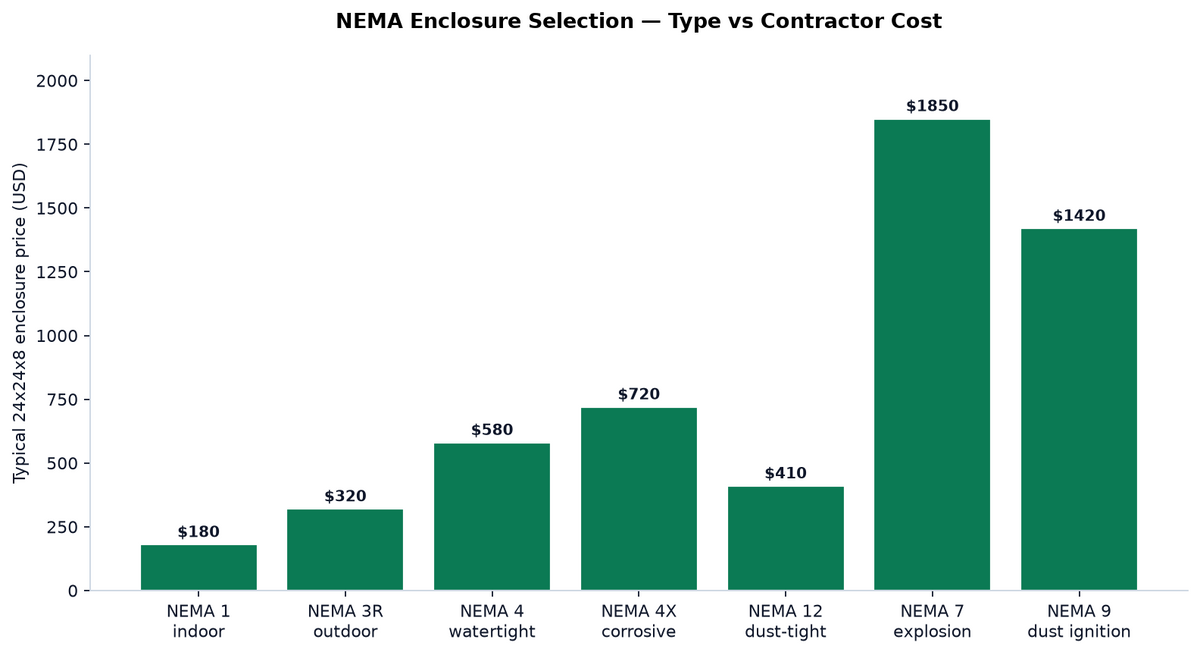
The rule of thumb: NEMA 1 for dry indoor, NEMA 12 for indoor dusty (industrial/factory), NEMA 3R for outdoor non-corrosive, NEMA 4/4X for washdown or outdoor coastal, NEMA 7 for hazardous locations Class I Div 1. If you order NEMA 1 for a food-processing washdown and IP44 hoses find the seams, you scrap the enclosure and eat a 30-40% cost margin.
| NEMA Type | Protection Against | Common Application | Typical PES SKU |
|---|---|---|---|
| NEMA 1 | Indoor dry; incidental contact | Panel rooms, control rooms | Hoffman A24H2408LP |
| NEMA 3R | Outdoor rain, sleet, ice | Outdoor disconnects, meter mains | Milbank U5168, Square D H364NRB |
| NEMA 4 | Windblown dust, splashing water, washdown | Food processing, dairy, breweries | Hoffman A20N20SS4, nVent A-20N16SS4 |
| NEMA 4X | NEMA 4 + corrosion | Coastal, chemical plants, WWTP | Hoffman A16N12ALP (fiberglass) or A16N12SS4 (SS) |
| NEMA 6 | Occasional submersion (30 min at 6 ft) | Below-grade pits, waste basins | Hoffman J-Panel or IP68 rated |
| NEMA 6P | Prolonged submersion (30 days at 6 ft) | Marine, mining, deep-pit installations | Custom stainless |
| NEMA 7 | Class I, Div 1 hazardous (explosive gas) | Refineries, chemical plants, paint booths | Adalet XCE, Cooper Crouse-Hinds |
| NEMA 9 | Class II, Div 1 hazardous (combustible dust) | Grain elevators, flour mills, coal handling | Cooper Crouse-Hinds ID-series |
| NEMA 12 | Falling dirt, dripping liquid; no washdown | Industrial factory floors, warehouses | Hoffman A-series painted |
| NEMA 13 | NEMA 12 + non-corrosive oil spray | Machine tool operator stations | Hoffman B-series painted |
Any electrical panel used in a commercial or industrial installation must be UL 508A listed — not just the components, but the assembled panel. This means: enclosure is UL 50 or 50E listed AT the specified NEMA rating; short-circuit current rating (SCCR) of the assembled panel is calculated and labeled; internal wiring meets UL 508A 28 (wire and terminal ampacity); and the panel nameplate carries the SCCR, supply voltage, and phase.
Contractors sometimes buy a raw NEMA 4X enclosure and stuff it with contactors from ten different manufacturers with no UL 508A listing. That panel fails at any AHJ inspection. If you are not a UL 508A panel shop yourself, buy pre-listed panels or subcontract the assembly to a UL 508A shop — PES can refer.
Three practical choices for most industrial enclosures:
- Painted mild steel — Cheapest ($150-$800 for 24x24x8). Indoor use only unless powder-coated for outdoor use. NEMA 12 default material.
- 304 stainless — 3-5x painted steel cost. Standard for food processing (NEMA 4X), pharmaceutical, and general industrial with occasional washdown.
- 316 stainless — 4-6x painted steel cost. Required for marine, coastal within ~10 mi of saltwater, chlorine-heavy chemical plants.
- Fiberglass (SMC or FRP) — 2-3x painted steel cost. Best when RF transparency matters (wireless sensors, antennas), when weight matters, or when the environment is aggressive but not saline. Nonconductive — good for UL 508A shops handling communications equipment.
Every enclosed electronic panel dissipates heat. The internal air temperature must stay within the equipment operating range — typically 40-50°C for industrial controls. NEMA TS 4 and IEC 60890 give the calculation methodology:
Total heat load (W) = sum of component heat dissipation ratings (from datasheets) × simultaneity factor (typically 0.7-0.9).
Enclosure surface area (m²) = 2 × (height × width + width × depth + height × depth) minus mounting surfaces.
Natural-cooling delta-T (°C) = heat load (W) / (5.5 × effective area (m²)).
If delta-T > 15°C above ambient, active cooling is needed — louvered filter fan pack (Hoffman F-series), thermoelectric cooler, air-to-air heat exchanger, or vapor-cycle AC.
| Brand | Product (linked) | Category | Contractor Price |
|---|---|---|---|
| Eaton | Eaton DH364NRK 200A 3PH Fusible Safety Switch NEMA 3R | Solar Kits | $1,672.34 |
| Eaton | Eaton Dura-blok Rooftop Channel Support 1' Channel 5' x 6' x 9.6' - DB10 | Racking & Mounting | $31.88 |
| Square D | Square D HOMT2020250 Circuit Breaker | Circuit Breakers | $92.38 |
| Square D | CIRCUIT BREAKER, QOU, 30A, 120/240VAC / 48VDC MAX, 2-POLE, SQUARE D, SURFACE OR DIN MNT, 1.5IN, QOU230 | Electrical | $86.23 |
| Schneider Electric | Schneider Conext SW 4.0KW 48VDC Inverter/Charger 120/240VAC - RNW8654048 | Hybrid Inverters | $2,000.00 |
| Schneider Electric | Schneider Conext SW 4.0KW 24VDC Inverter/Charger 120/240VAC - RNW8654024 | Hybrid Inverters | $1,600.00 |
UL 508A section 25 governs internal panel layout. Practical rules that pass inspection and simplify maintenance:
- Vertical spacing — Minimum 3" above each row of terminal blocks or contactors for wire routing and heat rise.
- Horizontal spacing — Minimum 1" between adjacent contactors sized 40 A and above; 2" for contactors sized 100 A and above.
- Wire duct fill — Maximum 50% cross-section filled with conductors; higher fill causes heat problems on high-current bundles.
- Terminal-to-cover clearance — Minimum 1.5" between energized terminals and the closed door.
- Wire size / lug rating — Match conductor size to the terminal's UL-rated range; do not double-up two smaller conductors on a single-conductor lug.
- Segregation — Class 1 (power) and Class 2 (signal, low-voltage) circuits routed in separate wire ducts or with barriers.
Panel layout software (Eplan, AutoCAD Electrical, Solidworks Electrical) with panel-shop design libraries dramatically reduces layout errors compared to freehand assembly.
NEC 250 grounding requirements do not stop at the enclosure surface. Inside the enclosure:
- DIN rails — Bonded to enclosure back panel or grounded bus bar; not floating.
- Back panel — Bonded to the enclosure at minimum 4 points on large panels (top, bottom, left, right).
- Door — Bonded to enclosure body via a flexible copper strap (bare or green-jacketed) sized 14 AWG minimum, at each hinge.
- Fiberglass and non-metallic enclosures — Internal grounding stud on back panel; conductors terminated to it.
- Panel-shop shielded cabling — Shield grounded at ONE end (typically the drive/PLC end) to avoid ground-loop noise.
Terminal blocks for grounding (green-yellow marked, distinct from red for hot and blue for neutral) are widely stocked by PES: Phoenix Contact UT-series, Wago 285-series, Weidmuller SAK-series.
Panel-shop wiring standards vary by application:
- MTW (Machine Tool Wire) — Type MTW single-conductor, stranded, PVC insulation. Rated for control-panel interior wiring. Widely used in industrial UL 508A panels.
- THHN/THWN stranded — Same rating as branch-circuit wire; stranded for flexibility inside enclosures. Common for higher-current internal wiring (30 A and above).
- TFF / TFN — 19-strand flex for control-cabinet doors where flex-life matters.
- Awg preference — Control 14-18 AWG, power up to 300 kcmil. Rarely more than 500 kcmil inside an enclosure (parallel conductors used above).
Wire colors follow common conventions: black hot, red hot (second phase), blue hot (third phase), white neutral, green ground. Purple for isolated ground; orange for high-leg on delta systems.
Outdoor enclosures (NEMA 3R and above) face additional environmental stress:
- Solar heat gain — Rooftop enclosures see 15-30°C above ambient. Sun shields (Hoffman SSN, nVent) reduce solar gain 30-50%. Air-conditioned enclosures for internal heat control.
- Corrosion — Painted steel is fine in dry / non-polluted air but corrodes rapidly in coastal or industrial atmospheres. Powder-coated painted steel gives 5-7 year outdoor life; stainless 25-50 years; fiberglass 40+ years.
- Cable entry sealing — Bottom-entry preferred; if top or side entry, use liquid-tight cable glands rated to the enclosure NEMA rating. IP68 or IP69K glands available.
- Condensation control — Breather-drain plugs (Hoffman DAV, nVent A-DR) allow moisture to escape without water ingress. On air-conditioned enclosures, insulate the back panel or use dew-point sensors to modulate cooling.
PES stocks Hoffman, nVent, Eaton B-Line, and Milbank enclosures in a range of materials suited to Louisville's climate (humid summers, moderate winters, minimal salt exposure).
Front-panel cutouts for pushbuttons, HMIs, and instruments must be laid out accurately. Standard practice:
- Pushbutton and pilot device cutouts — 22.5 mm and 30.5 mm rounds are standard IEC / NEMA sizes. Cut with hole saw or laser.
- HMI cutouts — Manufacturer-specific rectangular cutouts with corner-drilled relief holes. Verify dimensions from HMI installation drawing.
- Meter and instrument cutouts — 92x92 mm and 96x96 mm are standard panel-meter cutouts.
- Cable-entry cutouts — Sized to cable gland OD. Not to be located above 6 ft on tall enclosures (accessibility).
- Deburring and coating — All cutouts deburred and re-coated (paint touch-up or edge-sealing) to prevent corrosion at the cut edge.
Panel-shop laser or waterjet cutting is standard for production panels. Contractors doing one-off custom panels typically use nibbler, jigsaw, or unibit — slower but functional for prototype and low-volume work.
Article 690 PV and 706 ESS systems often require dedicated enclosures for combiners, disconnects, and monitoring. PES stocks the industry-standard options:
- PV combiner boxes — Combines multiple strings into a single output. NEMA 4X standard for rooftop installations. String fuses, DC disconnect, and monitoring built-in.
- Inverter disconnects — Between PV and inverter, and between inverter and grid. NEMA 3R outdoor standard; UL-listed rapid-shutdown compatible.
- Battery enclosures — UL 9540 listed ESS enclosures. Fire-rated 2-hr for interior installations; standalone weatherproof for outdoor. Include ventilation for gas-battery chemistries.
- Monitoring enclosures — Weatherproof housing for revenue meter, communication gateway, and cellular modem. NEMA 3R with heater and thermostat for cold climates.
Coordinate the enclosure order with the solar and ESS scope; different UL listings apply to solar accessories vs general electrical enclosures.
Panel-assembly economics depend on volume, complexity, and lead time:
- Buy pre-assembled OEM panels (Eaton MCC, Square D SquareD I-Line, Schneider Sinamics MCC) — Best when the specification matches a standard OEM offering. 15-25% cheaper than field assembly for standard configurations.
- Buy from a UL 508A panel shop — Best for custom / semi-custom panels in quantities 1-10. Portlandia partners with two UL 508A shops in Louisville metro; typical turnaround 4-8 weeks.
- Build in-house (if you are a UL 508A shop) — Best for very high-volume repetitive designs where in-house tooling and staff amortize cost. Setup requires UL 508A field-audit certification.
Portlandia sells raw enclosures, components, and complete panels — contractors can pick the combination that fits their scope and lead time.
Beyond the enclosure itself, NEC 250 requires bonding of the electrical system to building steel and metallic underground piping systems. Practical bonds required at every service:
- Bond to metal cold-water pipe within 5 ft of building entry (250.104(A)(1)).
- Bond to structural metal frame of building (250.104(C)).
- Bond to gas piping downstream of the utility meter (250.104(B)).
- Bond to underground metal water-service piping (250.104(A)).
Bonding jumper sizes from Table 250.104(A) based on service conductor size. Bonds terminate at the panel bus, ground bar, or grounding electrode conductor at a listed connector.
UL 508A requires specific documentation for each panel:
- Nameplate on enclosure exterior with voltage, phase, SCCR, manufacturer, and enclosure NEMA rating.
- Panel drawing with component layout, bill of materials, and terminal designations.
- Wire diagram showing all internal wiring, gauge, color, and destination.
- Short-circuit study documenting SCCR calculation and worst-case fault path.
- UL 508A audit records (if built in a certified panel shop).
Portlandia can supply raw enclosure and components; complete UL 508A panel assembly through partner panel shops or the customer's own certified facility.
Enclosure design should consider maintenance access:
- Door swing — typical 105-180°. Verify door can open fully in the installed location. Restraints for door swing beyond 105°.
- Component mounting height — standard eye-level (60-72") for HMIs; reachable (30-72") for pushbuttons and disconnects.
- Wire routing — conductors terminated at DIN rails and terminal blocks near their entry, not looped across the panel.
- Labeling — wire tags at both ends, component labels adjacent, terminal-block labels visible from the operator side.
- Test points — separate test terminals for common measurement points (analog signals, communication).
Well-designed panels save 40-60% of ongoing maintenance time. Push panel-shop assemblies through this ergonomic review before final sign-off.
UL 508A panels increasingly include networked components (PLCs, HMIs, VFDs, sub-meters). Cybersecurity best practices:
- Segregate control network from IT network via a firewall or air gap.
- Change default passwords on PLCs, VFDs, and HMIs at commissioning.
- Disable unused ports and protocols on networked devices.
- Update firmware regularly — especially security patches for Rockwell/Allen-Bradley, Schneider Modicon, Siemens SIMATIC, and Beckhoff CX PLCs.
- Physical security — keyed lock on panel doors, tamper-detect alarm on cabinet.
- Log access — maintenance events recorded for audit trail.
NERC CIP applies to bulk-power system panels; IEC 62443 provides a general framework for industrial control systems. Both increasingly referenced in insurance and regulatory audits.
Every UL 508A panel goes through a commissioning sequence:
- Continuity check — Verify all wire terminations against the schematic.
- Insulation resistance — Meg-ohm test to verify no shorts or unintended grounds.
- Point-to-point check — Every wire from schematic verified end-to-end.
- Component functional test — Each contactor, VFD, PLC input/output exercised.
- Sequential operation test — Full sequence tested with control commands from HMI or SCADA.
- Load test — Applied to actual motor or resistive load for final verification.
- Documentation — Test results signed off, saved to project file.
Panel-shop assemblies typically test the first four steps at the shop; contractor completes the last three on-site during commissioning.
Louisville metro climate factors that affect enclosure selection:
- Humidity — Summer humidity routinely 70-90%. Condensation control critical on unheated enclosures. Breather-drain plugs or thermostat-controlled heaters recommended.
- Temperature range — Summer 95°F peaks; winter 10°F lows. Enclosures should be rated for -30 to +50°C ambient.
- Air quality — Ohio River Valley is a moderate ozone and particulate zone. Outdoor enclosures accumulate deposits that shorten paint life. Powder-coated steel gives 5-7 years; stainless indefinite.
- Storm risk — Occasional derechos and ice storms. Structural mounting rated for 130 mph gusts is prudent for tall pole-mounted or roof-top enclosures.
- Corrosion zone — No coastal salt spray. Painted steel is sufficient for most outdoor commercial installations; stainless reserved for chemical plants (Rubbertown) and food processing.
Understanding UL 508A panel assembly cost helps contractors bid accurately:
- Enclosure (NEMA 12 painted steel 36x30x12): $450-$800.
- Back panel: $80-$150.
- DIN rail, wire duct, terminal blocks: $200-$500.
- Main disconnect and breakers: $400-$2,000 depending on ratings.
- Contactors and overload relays: $150-$600 per motor.
- PLC or relay logic: $500-$5,000.
- HMI (if applicable): $800-$3,500.
- Wiring, labels, and hardware: $200-$600.
- Panel-shop labor: $3,000-$10,000 depending on complexity.
- Documentation and UL 508A audit: $500-$1,500.
Total for a mid-size 4-motor panel with PLC and HMI: $8,000-$25,000 assembled and UL 508A labeled.
Large enclosures and switchgear require care in delivery and installation:
- Delivery inspection — Enclosures shipped on pallets or crates. Inspect for shipping damage before signing bill of lading. Photograph any damage, note on BOL, and file claim within 5 days.
- Storage — Indoor climate-controlled preferred. If outdoor, use tarps and elevate off ground. Enclosures with paper documentation inside deteriorate quickly in humid outdoor storage.
- Rigging — Free-standing enclosures > 200 lb require rigging plan. Lifting lugs standard on Hoffman and nVent free-standing gear.
- Foundation — Outdoor pad-mount enclosures require reinforced concrete pad, level within 1/4", with cable-entry conduit stubs pre-cast.
- Anchoring — Seismic Design Category C or higher requires anchor bolts sized per OEM's seismic bracket design.
- Grounding — Enclosure bonded to building grounding electrode system via a bonding jumper sized per NEC 250.66 or 250.122.
- Cable entry — Cable glands and hubs sized to maintain enclosure NEMA rating. Un-used holes filled with matching-rating plugs.
- Final cleanup — Remove all packing material, wire clippings, and dust. Verify no metal chips on live bus.
Custom UL 508A panels require close collaboration between the contractor, panel shop, and OEM. Portlandia's engineering team supports:
- Preliminary panel sizing and component selection based on load list.
- Enclosure specification (NEMA rating, dimensions, options).
- Component sourcing (Eaton, Square D, Siemens, Allen-Bradley, Rittal, Hoffman) with same-day quotes.
- Panel shop coordination — Portlandia works with three UL-listed Kentucky panel shops.
- Documentation review — schematic accuracy, wire numbers, terminal designations.
- Commissioning support — on-site or phone during startup.
Engineering desk hours: Monday-Friday 8am-5pm ET. Reach via portal chat, phone (Louisville main line), or direct email to engineering@pes.supply.
NEMA 4 vs NEMA 4X — when do I really need 4X?
IP66 vs NEMA 4 — are they the same?
Can I combine a NEMA 4X main enclosure with NEMA 1 sub-panels inside?
How do I calculate SCCR for a UL 508A panel?
Do fiberglass enclosures need internal grounding?
What is the max operating temp for typical industrial controls?
Order UL 508A Enclosures and Panels from PES
Hoffman, nVent, Eaton, Schneider fiberglass and stainless enclosures for industrial and outdoor applications.
Register Now