

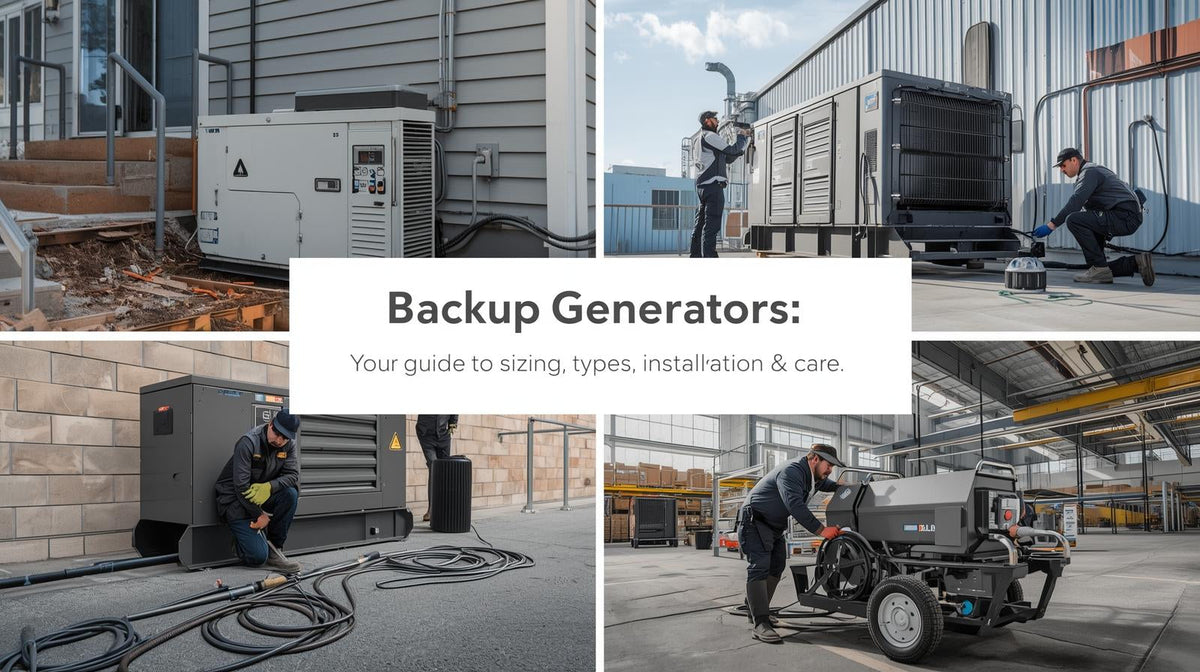
Updated September 2026 — refreshed against the live PES catalog; product pricing verified 2026-09-26.
I've been behind the counter at Portlandia Electric Supply long enough to recognize the phone call that comes in after every ice storm and every hurricane watch: "The power was out for nine hours. What do I need so that never happens again?" The honest answer depends on your loads, your fuel, and how much of the house you refuse to live without — and that's exactly what this guide walks through. We'll cover how backup generators actually make power, the real differences between standby, portable, and inverter units, a sizing worksheet with running and starting watts, fuel math in gallons and cubic feet per hour, the transfer switch that code demands, and the maintenance schedule that decides whether the thing starts when you need it. If you already know you want a permanently installed unit, browse our standby generators or standby home generators while you read.

Every generator does the same trick: an engine burns fuel to spin an alternator, and the alternator's rotating magnetic field induces AC voltage in the stator windings. What separates a $600 portable from a $12,000 standby system is everything wrapped around that trick — the engine quality, the voltage regulation, the enclosure, the control logic, and the switchgear that connects it to your panel safely.
A standby unit sits on a pad outside like a second HVAC condenser, plumbed into natural gas or a propane tank, wired through an automatic transfer switch. It watches utility power around the clock. When the grid drops, the controller starts the engine, waits for voltage and frequency to stabilize, and transfers your load — usually inside 10 to 30 seconds. When the utility comes back, it transfers you back and cool-down idles the engine before shutdown. You do nothing. That's the whole point.
Portable and inverter generators make you the control system: you wheel the unit out, fuel it, start it, and feed power through a manual transfer switch or heavy extension cords. Inverter generators add one more stage — they rectify the alternator's output to DC, then invert it back to clean 60 Hz AC — which is why they're quiet, fuel-sipping, and safe for laptops and medical electronics.
"The most reliable backup power starts with a properly sized ATS and a generator matched to your essential load profile. A smart controller that communicates with the panel and optional battery storage adds resilience you can actually rely on when the grid goes down."
— Maria Chen, Senior Electrical Engineer, Portlandia Electric Supply
Generator Types: Standby, Portable, and Inverter
| Type | Typical output | Startup | Fuel | Power quality | Best for |
|---|---|---|---|---|---|
| Standby (air-cooled) | 10–26 kW | Automatic, 10–30 sec | Natural gas or LP | Utility-grade, ±1–2% regulation | Whole-home or managed whole-home backup |
| Standby (liquid-cooled) | 30–150 kW | Automatic, 10–30 sec | NG, LP, or diesel | Utility-grade | Estates, small commercial, 3-phase service |
| Portable (open frame) | 2–12 kW | Manual recoil/electric | Gasoline, some dual-fuel | THD often 5–20% | Job sites, occasional outages, budget backup |
| Inverter generator | 1–7 kW | Manual recoil/electric | Gasoline, some dual-fuel | Clean sine wave, <3% THD | Sensitive electronics, RVs, partial loads |
Standby systems earn their price in one scenario: outages that happen when you're asleep, at work, or out of state, with a sump pump or a freezer full of food that doesn't care where you are. Portables earn theirs on flexibility and cost — same dollars, five times the watts, but you trade away automation and weather protection. Inverters are the scalpel: quiet enough for a campsite, clean enough for a CPAP, and small enough that "whole house" was never the promise.
One hybrid path worth knowing: a battery-based system with a hybrid inverter can carry the house through short outages silently, with a generator as the long-duration backstop. Our hybrid inverter guide covers that architecture in detail.
Every motor-driven load in your house has two appetites: the watts it draws once it's spinning (running watts) and the 2–7x spike it pulls for the first second or two (starting watts, driven by locked-rotor amps). Resistive loads — water heater elements, toasters, incandescent bulbs — draw the same at start as at run. A generator has to cover both: the simultaneous running total continuously, and the biggest motor's surge on top of it.
We pulled a 26 kW unit off a job last spring where the installer never checked the air conditioner's locked-rotor amps. The generator ran the whole house fine — right up until the compressor tried to start with everything else online, and the voltage dipped hard enough to reset every clock in the house. A $400 soft-start kit on the condenser fixed what a bigger generator would have papered over. Check the nameplate before you size anything.
| Load | Running watts | Starting watts |
|---|---|---|
| Central AC, 3-ton (36,000 BTU) | ~3,500 | ~7,000–10,500 |
| Central AC, 4-ton | ~4,700 | ~9,400–14,000 |
| Central AC, 5-ton | ~5,900 | ~11,800–17,700 |
| Furnace blower (1/2 HP) | ~800 | ~2,000 |
| Well pump (1 HP) | ~1,000 | ~2,500–3,000 |
| Refrigerator/freezer | ~700 | ~2,100 |
| Sump pump (1/2 HP) | ~1,050 | ~2,600 |
| Electric water heater | ~4,500 | ~4,500 (resistive) |
| Electric dryer | ~5,000 | ~6,000 |
| Microwave | ~1,000 | ~1,000 |
| Lights (whole home, LED) | ~400–800 | — |
| Home office + networking | ~300–500 | — |
| Garage door opener | ~550 | ~1,100 |
The worksheet math is four lines. Add the running watts of everything you expect to run at the same time. Find the single largest motor and swap its running figure for its starting figure. Add 20–25% headroom — generators are happiest at 60–80% of rated output. Divide by 1,000 and that's your minimum kW. For the full worked example and the NEC 220 method, see our standby generator sizing calculator.
Small Commercial Property
| Home / scenario | Typical coverage | Recommended size |
|---|---|---|
| Small home / essentials only (fridge, furnace fan, lights, sump, outlets) | No central AC, gas heat | 10–14 kW air-cooled |
| Average home, 1,500–2,500 sq ft, one 3–4 ton AC | Managed whole-home with load shedding | 18–22 kW air-cooled |
| Large home, 2,500–4,000 sq ft, one 5-ton or two smaller ACs | True whole-home | 24–26 kW air-cooled |
| Estate / 2+ large ACs / heavy electric appliances | Whole-home, no compromises | 36–48 kW liquid-cooled |
| Light commercial / very large residential, 3-phase service | Full facility backup | 50–150 kW liquid-cooled |
Sizing and Load Analysis
Two sizing traps we see every week. First, sizing to the panel instead of the load — a 200A service does not mean you need a 48 kW generator, because your diversified load almost never approaches the service rating; most 200A homes peak under 15 kW. Second, ignoring the natural-gas derate: a "26 kW" unit typically delivers around 24 kW on NG versus its LP rating, so size to the fuel you'll actually burn. Our whole-home generator sizing guide walks the worksheet end to end.
Ask me which fuel I put on my own shop and the answer is natural gas every time the meter is already there — no tank, no refueling, no deliveries, and the utility almost never drops gas and power at the same time. Rural customers don't have that luxury, which is why propane dominates farm country: a 500-gallon tank is days of runtime and the fuel never goes stale. Gasoline is the portable fuel — everywhere, cheap, and useless after six months in a can without stabilizer. Diesel is the commercial choice: best power density, best heavy-load efficiency, and the only practical option above roughly 60 kW.
| Factor | Natural gas | Propane (LP) | Gasoline | Diesel |
|---|---|---|---|---|
| Typical use | Residential standby | Residential standby, rural | Portable / inverter | Commercial, 30 kW+ |
| Storage | Utility piped — none on-site | 250–500 gal tank | Cans; stabilizer required | Base tank or day tank |
| Output derating | ~8–10% below LP rating | Full rated output | Full rated output | Full rated output |
| Runtime in an outage | Unlimited while utility gas is up | Days, set by tank size | Hours per fill | Days, set by tank size |
| Shelf life | N/A | Indefinite | 3–6 months unstabilized | 12+ months; polish for long storage |
| Cold-weather behavior | Unaffected | Tank pressure drops in extreme cold | Carb icing possible | Needs winter blend / additives |
| Maintenance burden | Lowest | Low | High (carb varnish) | Higher (fuel polishing, wet-stacking at light load) |
Fuel consumption is where oversizing stops being theoretical and starts billing you by the hour. These are typical published spec-sheet ranges for air-cooled standby units — always confirm against your model's sheet before quoting runtime to a customer:
| Unit class | LP @ half load (gal/hr) | LP @ full load (gal/hr) | NG @ half load (ft³/hr) | NG @ full load (ft³/hr) |
|---|---|---|---|---|
| 10 kW | ~1.0–1.4 | ~1.6–2.0 | ~110–140 | ~160–200 |
| 14 kW | ~1.4–1.8 | ~2.3–2.9 | ~150–190 | ~220–280 |
| 22 kW | ~1.8–2.3 | ~3.0–3.8 | ~200–280 | ~300–380 |
| 26 kW | ~2.0–2.5 | ~3.5–3.9 | ~230–300 | ~330–420 |
Propane (LPG)
Run the tank math before the storm does it for you. A 26 kW unit at half load burns roughly 2–2.5 gallons of LP per hour; a 500-gallon propane tank filled to its safe ~400 gallons yields about 4–7 days of continuous runtime for a large home. Drop to a correctly sized 14 kW and the same tank stretches past a week. Our generator fuel consumption chart has the fuller reference table.
The Transfer Switch Is Not Optional

NEC Article 702 requires a listed transfer means for any optional standby system, and the reason is written in line workers' safety: without a transfer switch, your generator can backfeed the utility and energize a "dead" line. Beyond code, the ATS is what makes a standby system automatic — it detects the outage, starts the unit, and moves the load in 10–30 seconds, then reverses the sequence when the grid returns.
I've pulled 4/0 copper through enough EMT to know the ATS wireway is where these installs go sideways — plan the conduit path between meter, switch, and panel before the pad gets poured. Match the switch to the service, not just the generator: whole-home coverage on a modern 200A service calls for a service-entrance-rated 200A ATS between meter and main panel, while essentials-only systems on 10–14 kW units can use a load-center ATS with a built-in sub-panel. Sizing math: a 26 kW unit on 240V single-phase delivers about 108 amps, which is why 200A service-entrance switches dominate. We stock automatic transfer switches from 100A to 800A — the Kohler 100A RDT indoor switch and the Kohler 100A with 16-circuit load center are the two we ship most for essentials-only jobs. For a deeper dive, see our guides to manual vs. automatic transfer switches and the transfer switch sizing chart.
A standby generator is a permitted appliance. Expect the AHJ to look at four things: setbacks and clearances (typically 5 ft from openings and combustible walls per manufacturer specs — follow the manual, not a rule of thumb), exhaust routing away from doors and windows, the gas or LP supply sizing (a 22 kW unit can demand over 300 ft³/hr, which often means upsizing the meter or the gas run), and the electrical interconnection. The code framework: NEC Articles 700 and 701 for emergency and legally required standby systems, Article 702 for optional standby, NFPA 110 where stored-energy and level-1/level-2 system requirements apply, and UL 2200 as the listing standard for stationary generator assemblies. Carbon monoxide is the quiet killer here — CO detectors in the house are cheap insurance and required by many jurisdictions with any fuel-burning appliance.
Portable-generator safety deserves its own paragraph because it's where people get hurt: never indoors, never in a garage with the door open, 20+ feet from windows with exhaust pointed away, and never backfeed a dryer outlet — a "suicide cord" can kill a lineman and will void every warranty and insurance policy attached to your house. If you want cord-free convenience without a standby unit, a manual transfer switch or interlock kit installed by a licensed electrician is the right path; our 240V outlet wiring guide covers the receptacle side of that conversation.
Generators fail at the worst moment for boring reasons: dead batteries, stale fuel, clogged filters, and engines that haven't turned over in a year. The maintenance schedule below covers typical air-cooled residential standby units — your manual's intervals win any disagreement.
| Task | Interval | Notes |
|---|---|---|
| Self-test / exercise cycle | Weekly (automatic) | Verify it runs; listen for hunting or rough idle |
| Visual inspection, oil level, leaks | Monthly | Clear debris from enclosure vents |
| Battery test | Every 6 months | Replace battery every 24–36 months — the #1 no-start cause |
| Oil and filter change | Every 100–200 run hours or annually | First change after 8–25 hour break-in |
| Air filter | Annually or 200 hours | Sooner in dusty sites |
| Spark plugs | Every 2–3 years or 300–400 hours | Air-cooled residential units |
| Fuel system (LP/NG regulator, lines) | Annual inspection | Leak-check connections |
| Coolant (liquid-cooled units) | Check monthly, service per manual | Test freeze protection before winter |
| Full-load test under real or load-bank conditions | Annually | Confirms ATS sequence and voltage regulation |
Keep a service log with dates, hour readings, and parts replaced — it preserves warranty eligibility and tells the next tech what kind of life the unit has lived. For gasoline portables, add one line to the calendar: drain or stabilize fuel before any storage longer than a month, because carburetor varnish is the reason "it ran fine last year" is the most expensive sentence in small engines.
Rural home, well pump, long outages
Acreage with a 1 HP well pump, propane heat, and a history of multi-day outages: 18–22 kW air-cooled on LP with a 500-gallon tank, load management so the well pump and range never fight the compressor, and a service-entrance ATS. Fuel planning is the whole game here — the generator is only as good as the tank behind it.
Suburban home, natural gas at the street
The bread-and-butter install: 18–22 kW on NG, 200A service-entrance ATS, soft-start on the 4-ton condenser if the compressor's locked-rotor amps are ugly. The Kohler 10kW with 100A 12-circuit ATS covers essentials-only versions of this job on a tighter budget, and the Champion 12.5kW is another select-circuit option we move regularly. For brand-level comparisons, our roundup of the best whole-house generators is the place to start.
Small commercial, zero tolerance for downtime
A storefront with POS, refrigeration, and security loads: liquid-cooled 36–60 kW with three-phase where the service demands it, remote monitoring, and a service contract. The Cummins RS50 50kW Quiet Connect is the unit we quote most in this class — liquid-cooled, quiet enough for a parking lot, and backed by a commercial dealer network.
Manufacturer warranties — typically 5 to 10 years parts-and-labor on residential standby units — all carry the same fine print: improper installation, neglected maintenance, and unauthorized fuel conversion void coverage. Document the commissioning, keep the service log, and use a licensed installer for the electrical and gas work. On the liability side, insurers increasingly ask about CO detection and permitted installation after generator-related claims; a permitted, inspected, UL 2200-listed install with a documented maintenance plan is the difference between coverage and a denial letter.
What size backup generator do I need for my house?
Add the running watts of everything that runs simultaneously, swap the largest motor's figure for its starting watts, and add 20–25% headroom. Most homes land at 10–14 kW for essentials only, 18–22 kW for a managed whole home, and 24–26 kW for large homes with big air conditioning. Our sizing calculator guide walks the full method.
Standby vs. portable generator — which is better?
Standby wins on automation, runtime, safety, and power quality; portable wins on cost and flexibility. If outages threaten a sump pump, medical equipment, or a freezer while nobody is home, standby is the only real answer. For occasional short outages and job-site use, a portable through a manual transfer switch does the job for a fraction of the price.
How long will a backup generator run on a propane tank?
A 26 kW air-cooled unit burns roughly 2–2.5 gallons of LP per hour at half load and 3.5–3.9 at full load, so a 500-gallon tank (usable ~400 gallons) delivers about 4–7 days of continuous runtime. Smaller, correctly sized units stretch the same tank past a week.
Do I need a permit to install a standby generator?
Yes, in virtually every US jurisdiction — electrical and usually mechanical/plumbing permits for the gas work. Expect inspection of setbacks, gas sizing, and the transfer-switch installation against NEC Article 702. Skipping permits risks failed inspections at sale time and denied insurance claims.
Can I install a backup generator myself?
The pad and landscaping, sure. The electrical interconnection and gas piping should be licensed work — most manufacturers require professional installation to keep the warranty valid, and the transfer-switch work carries real electrocution and backfeed hazards. A DIY job that backfeeds the grid is a liability you don't want to own.
How often should a standby generator be serviced?
Exercise weekly (automatic on most units), inspect monthly, change oil and filters every 100–200 hours or annually, test the battery every six months, and replace it every 2–3 years. An annual full-load test confirms the whole chain — engine, alternator, ATS — works end to end.
The customers who end up happiest all did the same three things: they ran the load worksheet before falling in love with a kW number, they picked fuel based on what's actually on the property, and they budgeted the transfer switch and installation alongside the generator instead of as an afterthought. Do those three and the brand decision gets easy.
Automatic Transfer Switches and System Integration
Bring us your panel schedule or circuit list and we'll size the system, quote the unit and the ATS, and arrange freight in one shot — we do this every day. Shop standby home generators, all standby generators, automatic transfer switches, and the full generators collection. Breaker and conductor sizing for the install lives in our standard breaker sizes chart.
Need pricing or availability on anything in this guide?
Portlandia Electric Supply dropships direct from the manufacturer — most items Ship Direct with lead times stated up front, no surprises.
Get a quote from PESBulk, pallet and contractor pricing available.


