

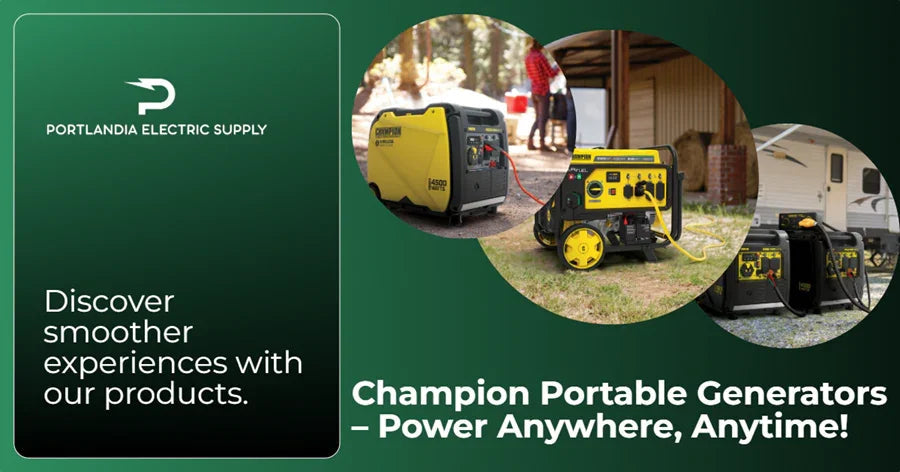
Champion Power Equipment built its reputation the hard way: generators that start on the second pull in January, at prices that don't require a second mortgage. I've sold, serviced, and personally run Champion units on job sites, at tailgates, and through multi-day outages, and this guide distills what actually matters — the technology choices, the sizing math, the fuel realities, and the safety rules — for anyone choosing a portable generator this year.

Reliable, Efficient, and Convenient Power Solutions for Every Need
Champion's catalog spans from 1,200-watt recreational inverters you can carry with one hand to 15,000-watt tri-fuel frame units that back up most of a house. What unifies the line is a value proposition: feature sets that competitors reserve for premium tiers — electric start, dual-fuel capability, CO Shield carbon monoxide shutoff, intelligauge displays — show up at mid-market prices. The company backs the generators with a 3-year limited warranty and lifetime technical support, and maintains a U.S.-based service network that actually answers the phone, which anyone who has ever needed a carburetor part in a storm week will appreciate.
You can browse the full lineup in our Champion generators collection, or compare against the broader portable generator catalog at PES Supply.
What Types of Generators Does Champion Offer?
The lineup divides into four families, and picking the right family is the first and most consequential decision:
| Family | Power Range | Engine Note | Typical Use |
|---|---|---|---|
| Recreational inverters (Mighty Atom, 2000W class) | 1,200–2,500W | ~80cc, ultra-quiet, 39–48 lbs | Camping, tailgating, electronics, van life |
| Mid-size open-frame inverters (3400–4500W class) | 3,100–4,500W | ~200cc, RV-ready 30A outlets, optional remote start | RVs, food trucks, job-site tools, home essentials |
| Conventional open-frame (dual-fuel and tri-fuel) | 4,000–12,000W running | 439–717cc, electric start standard on larger units | Home backup, construction, farm and ranch |
| Home standby (aC series, 14–22 kW) | 14–22 kW | Stationary, automatic transfer | Whole-home automatic backup |
Representative published specifications for the most-asked-about portables — always verify the exact model's spec sheet before purchase, as Champion revises SKUs annually:
| Representative Model Class | Starting Watts | Running Watts | Noise | Weight | Fuel |
|---|---|---|---|---|---|
| 2000W ultralight inverter | 2,000 | 1,600 | ~53 dBA at 25% load | ~39 lbs | Gasoline |
| 2500W dual-fuel inverter | 2,500 | 1,850 (gas) | ~53 dBA | ~48 lbs | Gas or propane |
| 3400W dual-fuel inverter | 3,400 | 3,100 (gas) | ~59 dBA | ~96 lbs | Gas or propane |
| 4500W RV-ready inverter, remote start | 4,500 | 3,650 | ~61 dBA | ~100 lbs | Gasoline |
| 7500W open-frame, electric start | 9,375 | 7,500 | ~72–74 dBA | ~200 lbs | Gasoline |
| 12,000W tri-fuel, electric start | 15,000 | 12,000 (gas) | ~78 dBA | ~330 lbs | Gas, propane, or natural gas |
How Do Champion Generators Stand Out in the Market?
Three differentiators come up repeatedly in head-to-head comparisons at our counter:
- Fuel flexibility at every tier. Dual-fuel (gasoline/propane) is available from the 2500W inverter class upward, and the flagship tri-fuel models add natural gas — a genuine rarity in portables that turns a 500-gallon home LP tank into a week of runtime.
- CO Shield on the current lineup. Champion's carbon monoxide monitoring shuts the engine down before CO accumulates to dangerous levels near occupied spaces. It doesn't replace the distance rules, but it's a real second layer.
- Parts and support depth. Consumables — air filters, carburetor kits, recoil assemblies — are stocked through a broad dealer network, and the lifetime phone support is staffed by people who can walk you through a valve adjustment.
What Is the Benefit of Electric Start Generators?
How Does an Electric Start Work?
An electric-start generator carries a small onboard battery feeding a starter motor on the engine flywheel — the same architecture as a car. Turn the key or press the button, the starter cranks the engine, the charging coil re-tops the battery while running. On Champion's larger frames, the battery is included; on several inverter models it's an option or standard depending on the SKU, so check the box contents.
What Are the Advantages of Using Electric Start Over Manual Start?
The honest answer: dignity and reliability at the worst moments. Recoil starting a 439cc engine at 20°F, in the rain, after the power's been out for six hours, is a task that separates enthusiastic owners from reluctant ones. Electric start removes the physical strength requirement entirely — which matters enormously for older homeowners, anyone with shoulder or back limitations, and anyone who'd rather not learn the choke-and-prayer ritual during an emergency. Remote start, available on Champion's 4500W inverter class, goes one step further: the generator stays under its cover outside and starts from a key fob inside the house or RV.
Are Electric Start Generators More Reliable?
The starting event itself is more consistent, yes — a starter motor cranks at a constant speed, where a tired human arm does not. But electric start introduces one maintenance item: the battery. Left flat for six months, a small AGM battery sulfates and dies, and your electric-start generator becomes a very heavy recoil-start generator (every Champion electric-start model keeps the recoil as backup, which is exactly the right design). The fix is trivial: a $30 battery tender on the garage shelf, or a monthly 15-minute run. I tell every customer the same thing — the generator you test monthly is the generator that works when it counts, and the battery is the only component that suffers from being ignored.
How Do Inverter Generators Work?
What Makes Inverter Generators Different from Traditional Generators?
A conventional generator's engine must spin at a constant 3,600 RPM to produce 60 Hz AC directly. An inverter generator decouples those two things: the engine drives an alternator producing high-frequency AC, which is rectified to DC, then inverted back to clean 60 Hz sine-wave AC by electronics. Because the engine no longer dictates frequency, it can throttle down at light load — that's where the fuel savings and quiet come from — and the electronic output stage delivers power clean enough for laptops and modern variable-speed appliances.
| Factor | Inverter Generator | Conventional Open-Frame |
|---|---|---|
| Power quality (THD) | Typically <3–5%, safe for electronics | Higher THD; fine for motors and tools, marginal for sensitive electronics |
| Noise at 25% load | 53–62 dBA (conversation level) | 68–78 dBA (vacuum-cleaner level) |
| Fuel use at light load | Engine throttles down; big savings | Constant 3,600 RPM regardless of load |
| Weight per watt | Heavier electronics, but smaller engines; generally lighter below 4,500W | Lighter per watt above ~5,000W |
| Price per watt | Higher | Lower |
| Parallel capability | Many models parallel-pair for 2x output | Not available |
Why Are Inverter Generators Considered More Efficient?
The efficiency claim is specifically a part-load claim. A conventional 7,500W generator burning fuel to spin at 3,600 RPM while powering a single refrigerator is wasting most of that fuel spinning iron. An inverter unit running the same fridge drops its engine speed, cutting fuel consumption roughly in half at light loads and cutting noise proportionally. At full rated load the two technologies converge — physics is physics — but real-world generator duty is mostly part-load, which is why inverter runtime numbers look so much better on the same gallon.
What Applications Are Best Suited for Inverter Generators?
Camping and RV use, where noise rules exist and neighbors are close; tailgating and events, where you're powering TVs and speakers; food trucks and mobile businesses with electronics; and home-backup-of-essentials for buyers who prioritize quiet and fuel economy over raw capacity. For whole-home backup above ~5,000W of real need, the economics flip to conventional frames or to a standby unit — you can cross-shop our inverter generator collection against the 5,000–9,000W class to see where your wattage lands.
How to Choose the Right Champion Generator for Your Needs
What Size Generator Do You Need for Your Home or Business?
Sizing is arithmetic, not guesswork, and it fails in one direction: people add up running watts and forget that motors need two to three times their running draw to start. The method that works:
- List the loads you actually need simultaneously — not everything you own. Refrigerator, freezer, furnace blower, a few lights, sump pump, and internet gear is a real emergency list; the electric range and hot tub are not.
- Write down running watts for each, then starting (surge) watts for every motor load.
- Total the running watts, then add the single largest surge on top of the running total of everything else.
- Add 20% headroom so the generator runs at 80% or less — engines last longer and run quieter there.
| Load | Typical Running Watts | Typical Starting Watts |
|---|---|---|
| Refrigerator (modern, 18–22 cu ft) | 150–200 | 600–1,200 |
| Chest freezer | 100–150 | 500–900 |
| Furnace blower (1/2 HP) | 400–600 | 1,200–1,800 |
| Sump pump (1/3 HP) | 800 | 1,300–2,400 |
| Well pump (1/2 HP, 240V) | 1,000 | 2,100–3,000 |
| Window AC (10,000 BTU) | 1,000–1,200 | 2,000–3,600 |
| Microwave (1,000W output) | 1,500 | 1,500 (no surge) |
| LED lighting circuit (10 bulbs) | 100 | 100 |
| Laptop + router + modem | 50–100 | 50–100 |
| Electric water heater | 4,000–4,500 | 4,500 |
Worked example: refrigerator (180 running), freezer (120), furnace blower (500), sump pump (800), lights and electronics (250). Running total: 1,850W. Largest surge is the sump pump at 2,400W, and since surges don't stack, the demand is 1,850 − 800 + 2,400 = 3,450W peak. Add 20% headroom: 4,140W running rating needed. That lands squarely on the 4500W inverter class or a 5,000W conventional frame — and it's why the 3–6 kW portable class is the volume seller for home essentials backup. Add a well pump or window AC and you step into the 6–10 kW class; our whole-house sizing guide covers the bigger math.
What Is Your Budget for a Portable Generator?
Honest price bands for the Champion line: recreational inverters run $400–$700; the 3400–4500W inverter class runs $800–$1,400 depending on dual-fuel and remote start; conventional 7,500–9,375W frames run $900–$1,500; and the big tri-fuel units reach $2,000–$3,000. Budget another $200–$600 for the connection hardware — a proper inlet box, interlock or transfer switch, and a heavy-gauge cord set — because a generator connected with a suicide cord is a hazard to you and to the line workers restoring your power.
Are There Specific Features You Should Prioritize?
In priority order, from years of watching what owners actually use: electric start (or remote start) if anyone but a healthy adult might need to run it; dual-fuel if you have propane on site or want shelf-stable fuel; a 30A or 50A RV/transfer-ready outlet rather than only 20A duplexes; an hour meter for maintenance tracking; and CO Shield on any unit that will ever run near the house. Wheel kits and folding handles matter more than spec sheets suggest at the 200-pound class.
Fuel: Consumption, Storage, and the Dual-Fuel Trade-Off
Fuel planning is where generator ownership gets real. Gasoline at 50% load, representative figures for the classes above (verify your model's spec sheet):
| Class | Gas at 50% Load | Tank | Runtime at 50% | Propane Note |
|---|---|---|---|---|
| 2000W inverter | ~0.1–0.15 gal/hr | ~1 gal | 8–10+ hrs | n/a |
| 3400W dual-fuel inverter | ~0.25 gal/hr | ~1.6 gal | ~7 hrs | ~14+ hrs on a 20-lb LP cylinder |
| 4500W inverter | ~0.3 gal/hr | ~2.3 gal | ~8 hrs | n/a (gas only on most SKUs) |
| 7500W open-frame | ~0.6–0.7 gal/hr | ~5.7 gal | ~8 hrs | Dual-fuel versions derate ~10% on LP |
| 12,000W tri-fuel | ~1.0–1.2 gal/hr | ~11 gal | ~9 hrs | LP and NG both supported; NG lowest output |
Three field truths about fuel. First, gasoline goes stale: untreated pump gas is suspect at three months and a carburetor-clogging risk at six. Stabilizer extends that to a year, and rotating your cans is cheaper than a carb cleaning. Second, propane doesn't go stale at all — a 20-lb cylinder bought in 2019 works fine today — which is the strongest practical argument for dual-fuel. Third, expect roughly a 10% power derate on propane versus gasoline, and more on natural gas; the spec sheets list it, and it matters when you're sizing close to the line.
How Long Can I Continuously Run My Champion Generator?
Two clocks limit continuous operation: the fuel tank and the oil. On fuel, even the big frames need a refuel roughly every 8–12 hours at meaningful load — which means a planned shutdown anyway. On oil, Champion's air-cooled engines call for the first oil change at 5 hours (break-in), then every 50–100 hours depending on model and conditions; during a multi-day outage, checking the oil at every refuel is the habit that prevents the expensive failure. In practice, owners cycle the unit: run through the evening and morning to hold refrigeration and climate loads, shut down overnight or midday to cool, refuel, and rest. For truly continuous weeks-long duty, the answer is a standby unit on natural gas, not a portable — the home backup collection and our standby sizing guide cover that path.
Safety: The Rules That Aren't Optional
Generators kill through two mechanisms, and both are preventable with rules rather than equipment:
- Carbon monoxide. Never run a generator indoors, in a garage (even with the door open), in a basement, or near windows, doors, or vents. The standard guidance is at least 20 feet from the house with the exhaust pointed away. CO Shield is a backup sensor, not permission to break the distance rule. Every storm season produces CO fatalities from exactly these mistakes, and they are all unnecessary.
- Backfeeding. Never connect a generator to a wall outlet — a "suicide cord" energizes the utility lines and can kill a line worker, and it will also destroy your generator when grid power returns. The legal connections are a listed transfer switch, an interlock kit on your panel, or extension cords run directly to loads. Our transfer switch collection and the manual transfer switch options cover the code-compliant hardware, and NEC 702 governs the installation.
- Grounding. Follow the manual for your exact model — most Champion portables have the neutral bonded to the frame, and NEC 250.34 generally does not require a separate ground rod for portable units feeding cord-connected loads; transfer-switched installations have their own bonding rules. When in doubt, the electrician connecting your inlet is the right person to settle it.
- Weather. Rain and generators mix badly. A generator tent or canopy keeps the unit dry while preserving ventilation; improvised enclosures that block airflow create both fire and CO hazards.
Model Deep Dives: The Units We Sell and Support Most
The 2000W Ultralight Inverter Class
Champion's 2000W inverter — the Mighty Atom generation and its successors — is the unit that converts generator skeptics. At roughly 39 pounds it's genuinely one-hand portable, at 53 dBA it hums rather than roars, and at 1,600 running watts it covers the modern camping and tailgating load list completely. Two of them pair with a parallel kit for 3,000+ watts when the need grows, which makes it the only generator purchase that scales by adding a second identical unit later. The honest limitations: no 30A outlet on the base unit (the parallel kit adds one), gasoline only, and a one-gallon tank that wants refilling mid-day under heavy load. For buyers whose entire need is "quiet power for recreation plus the fridge during outages," this class is the correct purchase and anything bigger is money spent on capacity you'll never use.
The 3400–4500W Inverter Class: The RV Standard
This is the segment where Champion took real market share, and the reason is a checklist no competitor matched at the price for years: true 30A RV receptacle, dual-fuel option, electric start, optional wireless remote start from 80 feet, and noise levels around 59–61 dBA that keep you inside campground rules. The 3,100–3,650 running watts cover a 13,500 BTU roof air conditioner with margin for the converter and microwave — the defining load test for RV duty. On the farm and job site side, this class runs a miter saw, an air compressor, or a refrigerator-plus-lights emergency circuit without disturbing the neighborhood. The trade-off to understand: inverter electronics at this size add cost per watt versus conventional frames, so if your loads are all motors and noise doesn't matter, the conventional 4,000W class delivers the same work for less money.
The 7500–9400W Conventional Frames: The Home Backup Workhorses
The 7500W running / 9,375W starting dual-fuel frame is the single most common "serious home backup" portable we move, and the configuration tells you why: a 439cc engine with electric start, an L14-30 twist-lock for transfer equipment, dual-fuel capability so the barbecue propane tank becomes a fuel reserve, and a 5.7-gallon tank good for roughly eight hours at half load. Paired with a 30A inlet box and interlock, it carries a well-managed home — refrigeration, furnace, sump, lights, electronics, and a window AC in rotation — indefinitely. What it won't do: run a 3-ton central air conditioner alongside everything else, or run quietly. At 72–74 dBA it's a vacuum cleaner parked in the yard, audible but tolerable, and the correct tool for its job.
The 12,000W Tri-Fuel Flagship
The tri-fuel flagship is the answer to a specific question: "I want near-standby capability without a permanent installation." Fifteen thousand starting watts and 12,000 running on gasoline — roughly 10,800 on propane and somewhat less on natural gas — plus a 50A outlet means it can feed a whole panel through a 50A inlet and carry loads no other portable touches, including larger central AC systems in managed rotation. The natural gas option is the sleeper feature: connected to the home's gas line by a plumber, it eliminates fuel logistics entirely and turns the unit into a semi-permanent installation. At 330 pounds it lives wherever you park it, the 78 dBA note announces itself, and the price approaches entry standby territory — but for buyers who can't commit to a permanent install (renters of homes, properties with setback problems, budgets phased across years), it closes most of the gap.
Cold Weather and Altitude: The Derating Nobody Mentions

Two environmental factors quietly steal generator capacity, and both are calculable. Altitude: naturally aspirated engines lose roughly 3–3.5% of their power per 1,000 feet above sea level. A 4,500W inverter at 7,000 feet in Colorado is effectively a ~3,400W unit — which is exactly the difference between starting the RV's air conditioner and not starting it. Champion publishes altitude guidance per model; carbureted engines may need a high-altitude jet kit above 3,000–5,000 feet, and fuel-injected models compensate automatically. Cold: engines make slightly more power in cold dense air, but batteries lose cranking capacity fast — a battery at 0°F delivers roughly half its warm-weather cranking amps, which is the mechanical argument for electric start units to live on a tender through winter, and for keeping the recoil starter practiced as the backup plan.
Connecting to Your Home: The Transfer Equipment Decision
Three code-compliant paths exist, in ascending order of capability and cost. The interlock kit — a listed sliding plate on your panel that mechanically prevents the main and generator breakers from both being on — pairs with an inlet box for the least expensive whole-panel solution, typically $300–$600 installed. You manually select which circuits the generator feeds. The manual transfer switch — a separate panel with 6–10 dedicated circuits — costs more ($500–$1,200 installed) but makes circuit selection switch-simple and is the most bulletproof option for non-technical family members. The 50A inlet with panel interlock at the large end lets the tri-fuel flagship feed essentially everything, with load discipline as the operating procedure. What all three share: they're installed by an electrician, they isolate your home from the grid positively and mechanically, and they eliminate extension-cord chaos. Extension cords direct to appliances remain legal and fine for a fridge and a few lamps — the moment you want the furnace or well pump, transfer equipment stops being optional.
Storage and Off-Season Care: Where Generators Go to Die
More portable generators are killed by storage than by use. The off-season protocol that prevents it: stabilize the fuel and run the engine five minutes to get treated fuel into the carburetor — or drain the carburetor bowl entirely for storage past two months; change the oil before storage rather than after, so acids from combustion don't sit on bearings all winter; remove the battery to a tender, or at minimum disconnect it; store under cover, off concrete if possible (a plywood square prevents the condensation that rusts frames); and tape a note to the fuel valve with the storage date and what's been done. Come storm season, the recommissioning is ten minutes: battery on, fresh fuel, oil check, start. I've resurrected generators that sat for three years with this protocol and watched identical-year units that skipped it need $200 carburetor work before they'd fire. The machine doesn't care about your intentions, only about fuel freshness and oil.
Champion's Home Standby Line: When to Stop Being Portable
Champion's stationary standby units — the 14 kW and 22 kW aC series — apply the same value philosophy to permanent installation: automatic weekly exercise, automatic transfer in seconds, natural gas or propane from the home's existing supply, and pricing that typically undercuts the established standby brands. The crossover math: if you're buying a big portable plus $600 of transfer equipment plus a cover plus fuel cans, and your outages run multi-day, the standby quote is often closer than expected. We stock and quote both paths — compare the Champion lineup with our standby generator collection, and the 22 kW guide explains what whole-home sizing looks like at the top of the range.
Warranty, Support, and Parts: The Ownership Experience
Champion's 3-year limited warranty on portable generators covers defects in materials and workmanship — engine, alternator, and frame — with normal wear items (filters, plugs, brushes on brush-type alternators) excluded. Registration at purchase matters; keep the receipt and register within the window in the manual. The lifetime technical support line is the differentiator owners mention after storms: a reachable human who can walk you through a no-start diagnosis — fuel, spark, air, in that order — while you're standing next to the unit. Parts availability runs deep through the dealer network for the common engines, and most consumables cross-reference to standard small-engine parts. Our counter stocks the fast movers — carburetor kits, recoil assemblies, filters — precisely because the week after a storm is the wrong week to wait on shipping.
The Seasonal Readiness Calendar
Generator ownership runs on a calendar, and the owners who never get surprised all follow some version of this one. Spring (March–April): full service after winter — oil change if due, fresh fuel, battery load test, and a loaded run before hurricane and storm season ramps. Early summer: verify the transfer equipment and cords, restock the spares bag, and check the fuel supply rotation. Fall (September–October): second loaded test, fuel stabilizer into anything that will sit, and a check of the CO Shield function per the manual before heating season adds furnace load to the emergency circuit. Winter: battery on the tender if the unit isn't on a scheduled run, and a cold-start drill on the first freezing weekend — discovering a weak battery during a January ice storm is a lesson best learned in a drill, not an emergency. Fifteen minutes a month, one service a year, and the machine is ready on the day everything else fails.
The Mistakes That Cost Owners Money
After years of warranty conversations and service counter triage, the expensive mistakes cluster into a short, predictable list. Avoid these and you've avoided most of what can go wrong:
- Buying on starting watts. The big number on the box is the surge figure, available for seconds. Size on running watts, and the surge takes care of itself. Buyers who shop the headline number end up one class too small.
- Running the tank dry during storage prep. Draining the tank but not the carburetor bowl leaves a few ounces of fuel to evaporate into varnish exactly where the jets live. Either run stabilizer through, or drain the bowl with the screw provided — half measures are how carburetors die.
- Chaining cheap extension cords. Two 16-gauge cords daisy-chained to a refrigerator drop voltage enough to stress the compressor motor. One properly sized 12-gauge cord, as short as practical, is the correct setup.
- Skipping the first oil change. The 5-hour break-in change is the cheapest engine insurance ever sold. Metal debris from initial wear circulates until you remove it; owners who skip it are running an abrasive bath.
- Testing the generator by starting it, not by loading it. A unit that starts and idles proves it makes spark and compression; it proves nothing about carrying load. The monthly test should include a real load — a heater, a few power tools — for fifteen minutes. Voltage under load is the test that matters.
- Positioning for convenience instead of safety. Every storm season, someone runs a generator in the garage "just this once" with the door open. The CO data on that mistake is unambiguous and fatal. Twenty feet, exhaust away, every time — or don't run it at all.
The common thread: none of these require expertise, only procedure. Write the procedure on the tape note on the fuel valve and the machine will outlive its warranty by a decade. And when something does go wrong, resist the urge to keep cranking — a generator that won't start after three honest attempts is telling you something, and the fuel-spark-air sequence diagnoses ninety percent of it in ten minutes with tools you already own. The remaining ten percent is almost always a battery, a tripped breaker on the unit itself, or a choke left on after warm-up.
How Can Champion Generators Enhance Your Outdoor Experience?
What Activities Can Benefit from a Portable Generator?
The recreational case is where the small inverters earn their keep. A 2000W class unit runs a campsite's lights, phone chargers, a portable fridge, and a coffee maker while staying quiet enough to hold a conversation next to it. The 3400–4500W class covers a travel trailer's roof AC (typically 1,400–1,800 running watts, with the starting surge handled by the inverter's peak), microwave, and entertainment system — and dual-fuel means the RV's own propane tanks feed the generator without carrying a separate gasoline can.
How Can You Use a Generator for Camping or Tailgating?
Tailgating math is simple and forgiving: a TV (150W), a satellite receiver (50W), a slow cooker (250W), a blender for the margarita station (400W surge), and string lights (50W) total under 1,000 running watts — squarely in 2000W inverter territory, with headroom to spare. Position the unit downwind and at least 20 feet from seating, bring a full tank plus one spare 5-gallon can for an all-day event, and you have 10+ hours of silent-partner power.
What Are the Best Practices for Using Generators Outdoors?
Keep it dry with a proper canopy, keep it level for oil circulation, keep it ventilated — never inside a tent, truck bed with a closed tonneau, or against a wall that reflects exhaust toward people. Use outdoor-rated cords sized to the load (12-gauge for anything over 15A), and coil excess cord loosely rather than leaving it spooled, where it can heat. At dusk, a small reflective marker or light on the unit prevents the classic trip-over-the-generator injury.
Maintenance: The Schedule That Keeps It Starting
Portable generator maintenance is genuinely simple, and the schedule below covers what Champion's manuals require for the air-cooled engines across the line:
| Interval | Task | Why It Matters |
|---|---|---|
| Every use | Check oil level; inspect air filter and fuel lines | Low oil shutdowns save engines; dirty filters kill power |
| First 5 hours (new unit) | Break-in oil change | Removes machining debris from the new engine |
| Every 50 hours or seasonally | Oil change (10W-30 typical; check your manual) | The single highest-value maintenance item |
| Every 100 hours or annually | Spark plug, air filter, fuel filter as equipped | Restores starting and fuel delivery |
| Every 250–300 hours | Valve clearance check (or dealer service) | Prevents hard starting and power loss |
| Monthly (storage) | 15-minute run under light load | Keeps the battery charged and fuel system wet |
| Long storage | Stabilize fuel or drain the carburetor | Stale fuel is the #1 cause of "won't start" |
Two additions from hard experience. First, keep a spare quart of oil, a spare plug, and a spare air filter in a bag zip-tied to the frame — during a regional outage, parts stores sell out by day two. Second, write the date of the last oil change and fuel fill on a piece of tape on the tank. Six months later, nobody remembers, and the tape doesn't forget.
Champion vs. the Competition: A Fair Counter View
Honda's EU series remains the quiet-and-refinement benchmark at a substantial price premium; Predator (Harbor Freight) undercuts everyone on price with thinner support; Generac's portable line matches Champion closely on features; Westinghouse and DuroMax compete directly in the dual-fuel value segment. Champion's durable advantage is the combination of dual-fuel availability across the range, the 3-year warranty with lifetime phone support, and parts depth. Where a buyer prioritizes absolute quiet for adjacent-campsite courtesy, Honda still earns its premium; where the priority is watts, features, and fuel flexibility per dollar, Champion is the default recommendation at our counter. You can cross-shop the alternatives in our DuroMax, Westinghouse, and Firman collections.
Buying Checklist: Ten Things to Confirm Before You Order
- Running watts with 20% headroom over your computed load.
- Starting watts covering your largest motor surge.
- Fuel type: gasoline, dual-fuel, or tri-fuel matched to what's on your property.
- Outlets: the 30A (TT-30 or L14-30) or 50A receptacle your transfer equipment or RV needs.
- Start type: recoil, electric, or remote — matched to who will operate it.
- Noise rating where neighbors or campground rules apply.
- Weight and wheel kit — a 200-lb unit without wheels is a two-person lift, every time.
- Hour meter for maintenance tracking.
- CO Shield or equivalent CO shutdown on the current production run.
- Warranty terms and your nearest service option before you need either.
Frequently Asked Questions
Are Champion generators reliable?
Champion has sold millions of engines and generators over two decades, backs the line with a 3-year limited warranty and lifetime technical support, and maintains a deep U.S. parts network. Reliability in practice tracks maintenance: units that get oil changes and fresh fuel start for years; units stored with stale gas and dead batteries fail when needed most — true of every brand, not just this one.
Can a Champion generator power my whole house?
The 12,000W tri-fuel class can carry most of a typical home's essentials plus major appliances through a proper transfer switch or interlock, but "whole house" depends on your loads — electric heat, central AC, and electric water heating together exceed any portable. A load calculation answers it definitively, and above roughly 12 kW of real need, a permanently installed standby unit becomes the right tool.
Is propane or gasoline better for a dual-fuel Champion?
Propane stores indefinitely, burns cleaner, and never gums a carburetor; gasoline carries more energy per gallon, delivers about 10% more power, and is easier to refuel on the road. The dual-fuel design exists so you don't have to choose permanently — most owners run propane for storage and outage duty and keep gasoline as the mobile option.
How loud is a Champion inverter generator?
The 2000–2500W inverter class runs around 53 dBA at quarter load — normal conversation level — while open-frame conventional units run 68–78 dBA. If the generator will run near campsites or suburban neighbors, the inverter's noise advantage is worth real money.
How do I break in a new Champion generator?
Run it with varied light-to-moderate loads for the first 5 hours — avoid sustained full-throttle max output — then change the oil to clear break-in debris. Check oil before every start during break-in. It's a one-evening investment that measurably extends engine life.
Can I run a Champion generator in the rain?
Not unprotected. Use a generator tent or canopy designed for running units — it shields rain while preserving airflow. Never operate in standing water, dry your hands before touching the unit, and shut down to refuel, always.
How long will a Champion generator last?
Air-cooled portable engines deliver roughly 1,500–3,000 hours with proper maintenance — at typical homeowner outage duty of 50–100 hours a year, that's a 15–25-year horizon. The generator outlasts several sets of batteries, plugs, and filters along the way, which is exactly how it's designed to work.
The Bottom Line
Champion's portable line wins on the fundamentals: the right wattage classes, dual-fuel and tri-fuel flexibility where it counts, electric and remote start options that remove the hardest part of generator ownership, and safety tech like CO Shield on current production. Size it with the arithmetic above, connect it with code-compliant transfer equipment, maintain it on the schedule in the table, and it will be the most dependable appliance you own on the worst day of the year. Shop the Champion collection, the dual-fuel lineup, or get a sized quote on our quote page.


