Tuesday's scan of the wires: a federal price floor on imported modules lands in seven weeks, China's export rebate removal is still working through the supply chain, NEC 2026 keeps rewriting generator rules, and the standby market just posted its biggest number yet. Here's what matters and what to do about it.
1. The $0.38/W module price floor is real, and it starts December 4
Presidential Proclamation 11052 sets a hard minimum import price of $0.38 per watt on any solar module built with imported cells or wafers — before the separate 15% tariff stacks on top. The floor reaches every stage of the supply chain: polysilicon ($21/kg), ingots and wafers ($100/kg), cells ($0.22/W), finished modules ($0.38/W). Goods imported before December 4 — including under fixed-price contracts signed before early August — are largely unaffected.
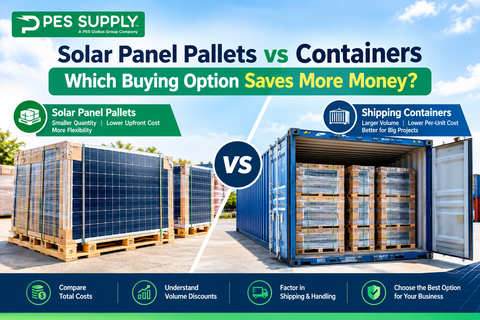
Buyer takeaway: if you have a Q1 2027 project, the module line item is cheapest right now. Our current solar panel inventory and pallet bundles are priced off pre-floor stock — that math changes in December.
2. China's rebate removal keeps pushing prices up the chain
China's April 1 cancellation of the 9% VAT export rebate on modules and wafers (cells phase out through January 1, 2027) removed exporters' ability to sell below variable cost. Trackers peg the post-change delivered price 18–24% above the January lock-in window. Layer on the preliminary 80–143% AD/CVD rates proposed against India, Indonesia, and Laos, plus the Section 232 polysilicon probe and the Section 337 TOPCon patent investigation, and 2026 procurement is a policy exercise as much as an engineering one.
3. SEIA: flat growth, but the domestic map is redrawing
SEIA's Q2 2026 market insight projects U.S. solar additions running flat from 2026 through 2031 — trade friction caps the upside. The manufacturing bright spot: domestic module output now covers roughly 70% of installations, though U.S. cell capacity is only ~3 GW, so "domestic" modules still lean on imported cells — exactly what the December price floor targets. Expect the domestic-content premium to keep widening.
4. NEC 2026 keeps tightening standby-power rules
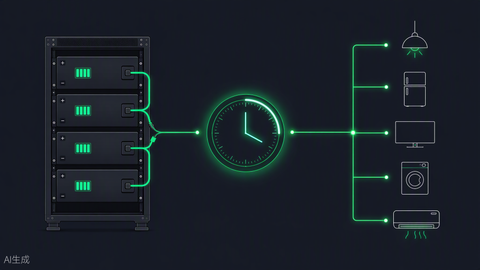
The 2026 code cycle's generator articles are now enforcing cleaner language and new hardware rules: "emergency stop" becomes "shutdown device" code-wide, and generators over 15 kW in non-dwelling occupancies need a marked, readily accessible remote shutdown. Article 702 still rules optional standby installs — transfer equipment that prevents backfeed is non-negotiable, and automatic systems must either carry the full connected load or prove load management. Our transfer switch collection covers both paths.
5. Standby power is a $5.45B market this year
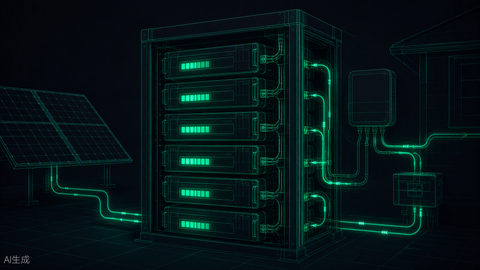
Whole-home standby demand keeps climbing on hurricane and wildfire exposure — the 2026 market estimate lands at $5.45 billion, with 22 kW as the default size for a ~2,500 sq ft home and 26 kW+ moving into larger estates. If you're speccing storm-season work, the 20–28 kW standby class and our full generator line are stocked, and our Generac vs Kohler spec comparison from yesterday has the numbers. Volume and project pricing: the wholesale desk.
Frequently asked questions
Does the $0.38/W floor apply to modules already in the U.S.?
No — it applies to imports on or after December 4, 2026. In-stock domestic inventory, like ours, is unaffected; what changes is what replacement stock costs after that date.
Should I pre-buy modules before December?
If you have a confirmed project schedule, locking current pricing is the defensible move. Bring the BOM to our desk and we'll quote against live stock.
Do NEC 2026 shutdown rules apply to my home generator?
The remote-shutdown mandate targets generators over 15 kW in occupancies other than one- and two-family dwellings, but dwelling installs still need an outside, readily accessible emergency shutdown device unless the unit is cord-and-plug portable. Your AHJ has the final word.