Enphase IQ8 vs APsystems QS1: Cost-Per-Watt Breakdown (2026)
One microinverter per panel versus one box per four panels — what that does to your per-watt cost, monitoring, and failure math.
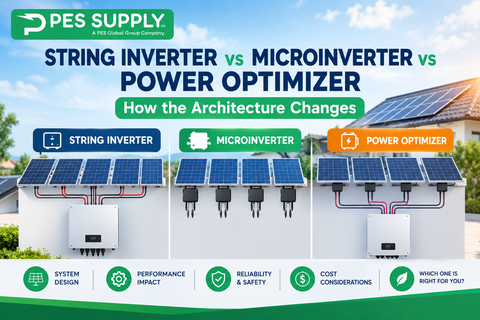
Both are 240V microinverter systems with module-level rapid shutdown and 25-year warranties. The difference is architecture: Enphase puts one IQ8 under every panel; APsystems' QS1 runs four panels from one unit. That single design choice drives the entire cost gap.
Head-to-head
| Enphase IQ8A | APsystems QS1 | |
|---|---|---|
| Architecture | 1 unit per panel (1:1) | 1 unit per 4 panels (quad) |
| Output per unit | 366 VA continuous | 1,200 VA shared across 4 inputs |
| MPPT | Independent per panel | 2 MPPT per unit (paired inputs) |
| Max panel wattage | ~505W class panels | ~550W+ class panels per input |
| Street price per unit | ~$210–230 | ~$180–220 |
| Hardware cost per panel | ~$210–230 | ~$45–55 |
| Monitoring brain | IQ Gateway (Envoy), ~$500+ | ECU, ~$150–250 |
| Warranty | 25 years | 25 years |
| Rapid shutdown | Module-level, NEC 690.12 | Module-level, NEC 690.12 |
| Single point of failure | 1 panel per failure | 4 panels per failure |
Where the extra $3,700 goes with Enphase
- True per-panel MPPT. Shade on one panel never touches its neighbor's input pair. On QS1, two inputs share an MPPT — a shaded panel can drag its pair-mate.
- Failure isolation. A dead IQ8 takes out one panel. A dead QS1 takes out four — and quad units run hotter and work harder, so the statistical failure exposure per unit is higher.
- Monitoring depth. Enlighten is the best homeowner-facing monitoring in the business — per-panel production, consumption metering options, battery integration if you add IQ Batteries later.
- Ecosystem lock-in (the polite term: integration). If an IQ8 battery or EV charger is in the future, staying all-Enphase is genuinely smoother.
Where QS1 wins outright
- Cost per watt — nothing else in microinverters comes close to ~$0.05–0.07/W hardware.
- Big panels. QS1's inputs accept 550W+ class modules that exceed IQ8A's comfortable pairing range; fewer units, fewer roof penetrations, faster installs.
- Installer labor. 5 units on the roof instead of 20 means less racking-adjacent labor, less trunk cable, faster commissioning.
The contractor answer
Shade-free, price-sensitive, big-panel jobs: QS1 — bank the savings. Complex roofs, heavy shade, monitoring-demanding customers, battery-roadmap customers: IQ8 — the per-panel MPPT and failure isolation earn their premium. Both are solid; the wrong answer is paying Enphase money on a flat, shade-free south roof where nothing will ever cast a shadow.
Microinverters by the pallet
IQ8 series and APsystems QS1/DS3 stock with contractor pricing — plus gateways, trunk cable, and the racking to hang them on.
Get an Inverter Quote →IQ8 vs QS1 — quick answers
Is APsystems as reliable as Enphase?
Enphase has the longer field track record and lower historical failure rates. APsystems' 25-year warranty matches Enphase on paper; the trade is four panels' exposure per unit failure instead of one.
Can QS1 run 550W panels?
Yes — QS1 inputs accept 550W+ class modules, one of its clearest advantages over the IQ8A's smaller pairing envelope. Check voltage/current windows against the specific panel's datasheet.
Do both meet rapid shutdown?
Yes — both provide module-level rapid shutdown per NEC 690.12, no separate RSD boxes needed.
What about batteries later?
Enphase wins if an IQ Battery is likely — same gateway, same app, one ecosystem. With APsystems you'd pair an AC-coupled battery (Powerwall-class or similar) instead.
Panel, inverter, and generator drops every Tuesday — plus printable sizing charts and contractor-only deals. No spam, unsubscribe anytime.
Portlandia Electric Supply · Technical Content Team · Street prices are typical ranges, not quotes; get your project's number from the desk. Verify datasheets for your panel pairing.