LONGi Hi-MO 6 vs Hi-MO X6 vs Hi-MO 7: Complete Solar Panel Buying Guide (2026)
Deep-dive on the three LONGi flagship families sold through PES Supply — Hi-MO 6 M10 PERC, Hi-MO X6 HPBC back-contact, and Hi-MO 7 HPBC 2.0. Cell technology, efficiency by wattage, temperature coefficient, warranty, BABA status, application matrix, and real stocked SKUs.

LONGi Solar is the world's largest photovoltaic manufacturer by shipments and PES Supply distributes 197 active LONGi SKUs across three generations: the M10 mono-PERC Hi-MO 6, the G12 HPBC (Hybrid Passivated Back Contact) Hi-MO X6, and the current-generation M11 HPBC 2.0 Hi-MO 7. This guide is what a contractor needs to walk from "24 kW residential rooftop with dark aesthetic" to a signed PO in one session: which family fits which application, what efficiency curves and temperature coefficients actually mean in a Louisville-summer rooftop, warranty terms, BABA-eligibility, and the exact SKUs in our warehouse today.
PES Supply is a direct-distributor for LONGi — every panel ships with full manufacturer warranty (25-year product on Hi-MO 7, 15-year on Hi-MO X6 flagship, 12-year on Hi-MO 6) and the option of PES contractor pricing across Tier 1 – Tier 3 with pallet freight quoted at checkout. Registered contractors also get the String Sizing Calculator inside the portal, which is important because Hi-MO 7 modules push Voc close to 50 V — string counts differ meaningfully from Hi-MO 6.
Every silicon PV module is defined by four choices: wafer size (M6/M10/G12/M11), cell architecture (PERC / TOPCon / HJT / IBC / HPBC / ABC), passivation stack, and encapsulation (glass-glass vs glass-backsheet, mono-facial vs bifacial). LONGi's three flagships each move that dial forward:
| Family | Cell architecture | Wafer | Typical STC efficiency | Where the gain comes from |
|---|---|---|---|---|
| Hi-MO 6 | Mono-PERC + gallium-doped p-type wafer | M10 (182 mm) | 20.9 – 22.6 % | Half-cut cells + PERC rear passivation. Mature, lowest cost/W. |
| Hi-MO X6 | HPBC — Hybrid Passivated Back Contact | M10 / G12 (210 mm) | 22.3 – 23.2 % | All electrical contacts on the rear — no front-side busbars, no cell gaps. All-black aesthetic. |
| Hi-MO 7 | HPBC 2.0 — Hybrid Passivated Back Contact 2.0 | M11 (~185 mm N-type) | 22.8 – 24.8 % | N-type substrate + optimized rear-junction stack. Lower LID + LeTID, better low-light response. |
What the abbreviations mean in installer terms. PERC (Passivated Emitter Rear Cell) is the mainstream mono-facial silicon cell that has dominated 2018–2023 residential installs — cheap, well-understood, but with a ~-0.34 %/°C temperature coefficient and 0.55 %/yr linear degradation. HPBC moves all metal contacts to the back of the cell, eliminating front-side shading from busbars and letting the module ship with a truly all-black aesthetic that HOAs love. HPBC 2.0 layers an N-type wafer under that architecture, dropping the temperature coefficient closer to -0.26 %/°C and the year-30 degradation floor to ~87.5 % of nameplate.
For the visual comparison of efficiency vs wattage across all three families, see the hero chart at the top of this guide.
| Spec | Hi-MO 6 (LR5-72HTH) | Hi-MO X6 (LR5-54HTH) | Hi-MO 7 (LR7-66HGD) |
|---|---|---|---|
| Rated power | 540 – 570 W | 420 – 445 W | 620 – 670 W |
| Module efficiency | 21.0 – 22.1 % | 22.5 – 23.2 % | 22.8 – 24.8 % |
| Cell type | Mono-PERC | HPBC | HPBC 2.0 (N-type) |
| Voc @ STC | 49.8 V | 38.6 V | 56.6 V |
| Isc @ STC | 13.9 A | 14.5 A | 15.4 A |
| Max system voltage | 1500 V DC (UL) | 1500 V DC (UL) | 1500 V DC (UL) |
| Temp coef Pmax | −0.34 %/°C | −0.29 %/°C | −0.26 %/°C |
| Product warranty | 12 yr | 15 yr | 25 yr |
| Performance warranty | 25 yr @ 84.8 % | 25 yr @ 89.0 % | 30 yr @ 87.4 % |
| 1st-yr degradation cap | 2.0 % | 1.0 % | 1.0 % |
| Linear degradation | 0.55 %/yr | 0.45 %/yr | 0.35 %/yr |
| Dimensions | 2278 × 1134 mm | 1722 × 1134 mm | 2382 × 1134 mm |
| Weight | 27.5 kg | 21.5 kg | 32.8 kg |
| Frame | Silver / Black anodized alum. | Black anodized alum. | Silver / Black anodized alum. |
| Backsheet / rear | White / Transparent | Black transparent EPE | Glass-glass (bifacial option) |
| Connector | MC4 EVO2 | MC4 EVO2 | MC4 EVO2 |
| Fire rating (UL 61730) | Type 1 | Type 1 | Type 1 |
| Ecolabel | TÜV, IEC 61215/61730 | TÜV, IEC 61215/61730 | TÜV, IEC 61215/61730 · IEC TS 63397 |
Register the S/N within 90 days or lose the extended warranty.
LONGi's 25-year Hi-MO 7 product warranty and the 30-year performance warranty both require online registration inside 90 days of commissioning. PES auto-registers eligible warranties for verified contractor accounts at ship — but on drop-shipped or forwarded orders the site host is still responsible. Registration URL: en.longi.com/support/service.html.
Datasheets always look great at STC (25 °C cell temp, 1000 W/m² irradiance, AM 1.5). The real question for a Louisville-summer rooftop is: what does the module produce at a 65 °C back-of-module temperature at 900 W/m²? That's where temperature coefficient dominates and where HPBC 2.0 starts to pull ahead of PERC by 3-5 % on annualized yield for the same nameplate wattage.
Worked example — 12 kW system in Louisville, KY. At July peak sun with an ambient 33 °C and a back-of-module 62 °C, a 22-panel string of Hi-MO 6 555W produces roughly 10.35 kW-DC after temperature de-rating. The same 22-panel string of Hi-MO X6 620W produces roughly 12.05 kW-DC. The same 22-panel string of Hi-MO 7 660W produces roughly 13.10 kW-DC. Cost/W is different across all three, but so is the delivered kWh — HPBC 2.0's better temp coefficient recovers 3-5 % more energy at the hot end of the summer envelope.
Year-30 output — same rooftop, same 12 kW nameplate DC
- Hi-MO 6 (PERC · 25-yr @ 84.8%): Year-1 = 98.0% × nameplate. Year-30 ≈ 82.5% (extrapolated past the 25-year warranty).
- Hi-MO X6 (HPBC · 25-yr @ 89.0%): Year-1 = 99.0% × nameplate. Year-30 ≈ 87.4% (extrapolated).
- Hi-MO 7 (HPBC 2.0 · 30-yr @ 87.4%): Year-1 = 99.0% × nameplate. Year-30 = 87.4% at warranty floor.
The Hi-MO 7 warranty is 5 years longer than Hi-MO X6, and its year-30 floor is warranted — the others are extrapolations off the 25-year curve. On a 25-year commercial PPA that's the difference between an audit passing and failing.
Domestic-content rules matter on any project that touches federal money (IRA §48 domestic-content bonus, ITC 10-percent kicker), or on prevailing-wage / Davis-Bacon rooftops. LONGi ships from three assembly points relevant to the US:
| LONGi assembly | Country of origin | BABA build-out status | IRA §48 domestic content |
|---|---|---|---|
| China (Xi\'an, Chuzhou) | China | Not BABA | Not eligible |
| Malaysia (Kuching Sarawak) | Malaysia | Not BABA | Not eligible |
| USA — Pflugerville, Texas (Illuminate joint venture, 5 GW capacity, phase-1 online 2024) | USA | DAM Assembled in USA | Module assembly eligible · cell content still ex-US in 2026 |
Practical implications for the PO clerk. If your project needs the ITC domestic-content adder, spec Hi-MO 7 55B-M-US (the Pflugerville-assembled SKU that PES flags as DAM in the SKU code). If it doesn't (behind-the-meter residential, no federal money involved), the Malaysia-assembled Hi-MO X6 saves 8-12 %/W over the DAM variant. See the BABA + DAM Solar Panels reference guide for the full IRA §48 domestic-content calculation.
Rooftop load — check code before speccing Hi-MO 7.
Hi-MO 7 660W is 32.8 kg (72.3 lb) on a 2382 × 1134 mm footprint. On a residential composition-shingle rooftop that's ~2.66 psf module weight + mounting hardware — inside typical IRC 15 psf DL allowance but tight for older 1970s construction. On commercial ballast systems (S-5!, IronRidge Ballasted, PanelClaw) it changes the ballast pattern. Pull the structural PE letter before finalizing. Hi-MO 6 555W and Hi-MO X6 445W are both under 27.5 kg — a drop-in for most refurbishment jobs.
Rail vs shared-rail — pitch cells matter.
Hi-MO 6 has 4 mounting holes on a 400/1400 pitch matching IronRidge XR-100/XR-1000 rail with universal fastening objects. Hi-MO X6 is short (1722 mm) — you can install two rows on the same section of XR-100 rail without extra splice hardware. Hi-MO 7 is long (2382 mm) — plan an extra rail section per horizontal row on portrait layouts, or shift to landscape.
MC4 EVO2 connectors — do NOT mix with MC4 originals.
LONGi ships MC4 EVO2 (Stäubli's upgraded lug + O-ring design). They mate with Amphenol H4 and other cross-lock MC4 clones on paper, but the AHJ-accepted install uses same-manufacturer connectors within one series circuit — this is Stäubli's stated position, and it's stronger on Hi-MO 7 where module Isc is 15.4 A. If you're splicing to home-run MC4 originals, use a same-brand adapter or replace the run.
Rapid-shutdown — MLPE required for module-level.
LONGi modules don't ship with integrated RSD. For NEC 690.12 module-level rapid shutdown, pair with Tigo TS4-A-F, APsmart RSD-S/D, or a microinverter architecture (Enphase IQ8+/IQ8H, APsystems QT2). String-level RSD from the inverter (Sol-Ark 15K, SolarEdge Home Wave) is acceptable in many AHJs but not module-level per 2020+ NEC 690.12(B)(2). Check with your AHJ.
Bifacial gain — Hi-MO 7 bifacial variants add 5-15% yield.
The Hi-MO 7 glass-glass bifacial variant (LR7-66HGD-BF) has an 85% bifaciality factor. Mounted 24" or more above a light-colored roof or ground surface (albedo 0.5+), it produces 8-12% more energy than the equivalent mono-facial variant. On a ballasted commercial flat-roof with a white TPO membrane, we've seen 15%+ bifacial gain in third-party test data. For ground-mount farms this is the volume LONGi Wp choice.
| Application | Recommended family | Why |
|---|---|---|
| Residential rooftop, dark aesthetic, HOA | Hi-MO X6 420-445W | All-black, no busbar shading, 22.5-23.2 % — the aesthetic winner. |
| Residential rooftop, cost-optimized, no HOA | Hi-MO 6 540-570W | Cheapest $/W in the LONGi lineup — mature, well-supported. |
| Residential rooftop, 25-yr PPA / long-warranty | Hi-MO 7 620-670W | 30-yr performance warranty · warranted year-30 output floor. |
| Commercial rooftop, high production density | Hi-MO 7 660-670W | Highest Wp per square meter · fewer racking/MLPE units per kW. |
| Utility-scale ground mount, 1500 V DC | Hi-MO 7 bifacial | Bifacial gain 8-15% · lowest $/kWh over 30 yr. |
| BIPV / carport / dual-glass required | Hi-MO 7 bifacial glass-glass | Glass-glass certified for BIPV loading + hail. |
| Federally-funded / domestic-content bonus (ITC §48) | Hi-MO 7 US-DAM (Pflugerville) | DAM stamp qualifies module assembly for IRA §48 domestic-content |
| Retrofit on rail from a Hi-MO 4/5 install | Hi-MO 6 same-frame | Drop-in dimension match — no rail rework. |
Every SKU below is stocked in the PES Louisville warehouse or on a bonded pipeline PO. Prices shown are public retail; verified contractor accounts see 5–22% off list at Tier 1 – Tier 3. Freight is quoted at checkout.


Step 1 — Set the aesthetic constraint.
All-black rooftop? Hi-MO X6 or Hi-MO 6 all-black variant. Silver frame acceptable? All three families are on the table. HOAs and premium residential neighborhoods overwhelmingly require all-black, which prices Hi-MO X6 into the shortlist at 22.5-23.2 % efficiency.
Step 2 — Fix the warranty budget.
25-yr product / 30-yr performance is a 5-8 %/W premium. If the customer is a 25-yr PPA operator or a school district doing prevailing-wage, that's the right budget. If it's a homeowner doing cash on a 20-year roof, Hi-MO 6 at 12-yr product / 25-yr performance is the value pick.
Step 3 — Confirm domestic-content requirement.
Federally-funded, IRA §48 domestic-content bonus, or Davis-Bacon? Spec Hi-MO 7 US-DAM (Pflugerville-assembled). Behind-the-meter residential without federal $? Malaysia-assembled Hi-MO X6 or Hi-MO 6 is 8-12% cheaper.
Step 4 — Do the string voltage math (LONGi Hi-MO 7 is high-Voc).
Hi-MO 7 Voc at -20 °C hits ~62 V — string of 12 sits at 744 V, string of 13 at 806 V — that's well over 800 V of the popular 1000 V DC residential inverters. Use the PES String Sizing Calculator to temp-correct and match to your inverter's Vdc-max. Hi-MO 6 and X6 are lower Voc — more forgiving.
Step 5 — Verify rail + RSD compatibility.
Hi-MO 7 is a longer module — plan for extra rail per portrait row, or flip to landscape. All LONGi flagships need module-level RSD (Tigo TS4-A-F, APsmart RSD-S/D) or MLPE (Enphase, SolarEdge) to hit NEC 690.12 module-level compliance.
What is the difference between LONGi Hi-MO 6, Hi-MO X6, and Hi-MO 7?
Hi-MO 6 is LONGi's mainline mono-PERC family on M10 wafers — the residential and commercial volume line at 540-570 W and 21.0-22.1% efficiency. Hi-MO X6 uses LONGi's HPBC (Hybrid Passivated Back Contact) architecture on M10/G12 wafers — all-black, no front-side busbars, 22.5-23.2% efficiency. Hi-MO 7 uses HPBC 2.0 layered on an N-type wafer — 22.8-24.8% efficiency, best-in-class temperature coefficient (-0.26 %/°C), and a 25-year product / 30-year performance warranty. Cost/W scales with efficiency: Hi-MO 6 < X6 < 7.
Which LONGi module is BABA-compliant for federally-funded jobs?
The Hi-MO 7 US-DAM variant assembled at LONGi's Pflugerville, Texas facility (Illuminate USA joint venture) carries a Domestic Assembled Module stamp that qualifies module assembly for the IRA §48 domestic-content bonus. Cell content remains ex-US in 2026 — full BABA compliance (including cell manufacturing) is on the roadmap for 2027. For behind-the-meter residential without federal money, Malaysia-assembled Hi-MO X6 and Hi-MO 6 are 8-12% cheaper per watt.
What is HPBC and how does it differ from TOPCon or HJT?
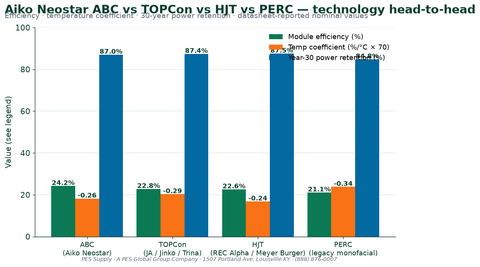
HPBC — Hybrid Passivated Back Contact — is LONGi's back-contact cell architecture where all electrical contacts (both the positive and negative junctions) live on the rear of the cell. That eliminates busbar shading on the front, letting the module ship fully black. TOPCon (used by JA Solar DeepBlue and Jinko Tiger Neo) is a front-contact N-type cell with a tunnel-oxide passivation layer at the rear — front busbars visible. HJT (used by REC Alpha Pure and Meyer Burger) uses heterojunction between amorphous and crystalline silicon — also front-contact. HPBC gains aesthetic and shading advantages; TOPCon and HJT gain slightly better temperature coefficient and low-light response. HPBC 2.0 layers N-type wafer under HPBC to close the temperature-coefficient gap.
What temperature coefficient should I design for on a Louisville rooftop?
Louisville-summer back-of-module cell temperatures routinely hit 60-65 °C at July peak sun. At -0.34 %/°C (Hi-MO 6 PERC), that's a 13.6% derating from STC. At -0.26 %/°C (Hi-MO 7 HPBC 2.0), that's 10.4% derating. The 3.2% delta over a 12 kW residential system is ~380 W of extra continuous output on peak days — meaningful for battery-backed self-consumption designs. Always design string voltage against the coldest expected cell temp for the ZIP (Louisville records -22 °C historical low) — see the PES String Sizing Calculator.
How does LONGi Hi-MO 7 compare to JA Solar DeepBlue 4.0 and Jinko Tiger Neo?
All three are N-type panels — JA DeepBlue 4.0 and Jinko Tiger Neo are both TOPCon architectures, while LONGi Hi-MO 7 is HPBC 2.0 (back-contact N-type). At 555-585 W class: DeepBlue 4.0 is 21.5-22.0% efficient, temp coef -0.30 %/°C, 30-yr performance @ 87.4%. Tiger Neo is 21.5-22.5% efficient, temp coef -0.29 %/°C, 30-yr @ 87.4%. Hi-MO 7 at 620-670W is 22.8-24.8% efficient, temp coef -0.26 %/°C, 30-yr @ 87.4%. Hi-MO 7 wins on efficiency and temp coefficient; the TOPCon panels win on price. See our dedicated JA DeepBlue vs Bluesun vs Trina comparison.
What warranty terms come standard on PES-shipped LONGi panels?
Hi-MO 6: 12-year product, 25-year performance @ 84.8%. Hi-MO X6: 15-year product, 25-year performance @ 89.0%. Hi-MO 7: 25-year product, 30-year performance @ 87.4%. Warranties require online registration inside 90 days of commissioning. PES auto-registers eligible warranties for verified contractor accounts at ship — see the pallet packing list for the registration confirmation ID.
Do LONGi panels need module-level rapid shutdown (RSD)?
LONGi doesn't ship integrated RSD electronics inside the junction box. For NEC 690.12(B)(2) module-level rapid shutdown compliance, pair LONGi modules with Tigo TS4-A-F, APsmart RSD-S/D, or Fortress RSD initiator + module devices — or step up to a microinverter architecture (Enphase IQ8+/IQ8H, APsystems QT2/DS3). String-level RSD from the inverter (Sol-Ark, SolarEdge Home Wave) is compliant in many AHJs but not module-level per 2020+ NEC — always confirm with your AHJ.
What's the difference between mono-facial and bifacial LONGi modules?
Mono-facial modules have a white or transparent backsheet — 100% of production comes from the front glass. Bifacial modules have glass on both faces (glass-glass) and produce additional energy from light reflected onto the rear cell. Hi-MO 7 bifacial variants have an 85% bifaciality factor — a rear cell mounted 24 inches above a white TPO roof or high-albedo ground surface adds 8-15% to the system's annualized yield. For ground-mount farms and light-albedo commercial roofs, bifacial is the default; for asphalt shingles it adds nothing meaningful.
How many LONGi panels fit on a 21-foot pallet for freight?
LONGi standard pallet counts (approx): Hi-MO 6 555W — 31 modules/pallet (~62 kg/mod = 1922 kg gross). Hi-MO X6 440W — 36 modules/pallet (short module, higher stack). Hi-MO 7 660W — 27 modules/pallet (larger footprint). PES quotes LTL / FTL freight at checkout by ZIP against Yellow, XPO, and Estes carriers; pallet-quantity POs frequently qualify for freight offset at Tier 2 volume. Use the PES Freight Calculator for a live rate.
Does PES Supply offer contractor pricing on LONGi?
Yes — verified installer accounts get Tier 1 pricing (5-12% off list) at registration, Tier 2 volume pricing (8-18% off) at $25k/quarter, and Tier 3 pallet/EPC pricing (12-22% off + custom freight) on full pallet or container POs. Register at axis.pesdistribution.com/portal-registration — EIN + resale certificate required, verification inside 4 business hours EST.
Which LONGi module should I spec for a 12 kW residential install?
For a 12 kW residential rooftop, 22 panels of Hi-MO 6 555W (12.21 kW-DC) is the cost-optimized answer. 20 panels of Hi-MO 7 620W (12.40 kW-DC) is the premium answer — 2 fewer panels means less racking, less RSD, less MLPE, and a 30-year warranty. For all-black aesthetics with the smallest footprint, 28 panels of Hi-MO X6 440W (12.32 kW-DC) is the visual winner. All three are stocked at PES.
Are LONGi panels compatible with SolarEdge and Enphase optimizers / microinverters?
Yes — LONGi Hi-MO 6, X6, and 7 all appear on SolarEdge's approved-vendor list (with S-series and P-series optimizers) and on Enphase's IQ8+/IQ8H/IQ8P compatibility matrix. For Enphase, verify Voc and Isc are inside the microinverter's DC input range — Hi-MO 7 620W Isc of 15.4 A pairs cleanly with IQ8P (16 A max input). Use the PES Compatibility Checker for live inverter + panel + battery verification.
Open a PES Supply contractor account
Direct-distributor pricing on the full PES Supply solar panel catalog — LONGi, Aiko, JA Solar, Jinko, REC, Silfab, Bluesun, Trina, Canadian Solar, SunPower. Louisville-warehoused, pallet-freight quoted at checkout. Registered contractors also get the PES portal String Sizing, Compatibility, and Freight calculators — cross-links to the Solar Inverter Distributor Hub and the Racking & Mounting Hub live inside the portal.
Register for contractor pricing