Jinko Tiger Neo N-Type vs Canadian Solar HiKu — Utility-Scale Panel Comparison (2026)
The two Tier-1 utility-scale flagships head-to-head — Jinko Tiger Neo N-Type (585-635W) vs Canadian Solar HiKu / TOPBiHiKu7 (545-700W). Cell technology, cost per watt-DC, temperature performance, warranty structure, BABA status, and every stocked SKU at PES Supply.

Utility-scale solar in 2026 runs on two panel families through PES Supply: Jinko Solar's Tiger Neo N-Type (585-635W) and Canadian Solar's HiKu / TOPBiHiKu7 (545-700W). Together they represent 246 active SKUs in the PES Louisville warehouse. This guide is what an EPC developer needs to walk from "5 MW-DC ground mount, single-axis tracker" to a signed pallet PO in one session — head-to-head specs, temperature performance, warranty structure, BABA status, and cost per watt-DC delivered to Louisville.
The two brands compete on the same slot in the utility BOM: 1500 V DC bifacial glass-glass, N-TOPCon architecture, ~2.4 m² footprint, MC4 EVO2 connectors. The differences are peak wattage (Jinko 635W vs Canadian TOPBiHiKu7 700W), cost per watt-DC ($0.24 vs $0.22 at pallet-quantity Tier 3), and warranty structure. Both offer US-DAM SKUs for IRA §48 domestic-content bonus eligibility.
Utility ground mount and single-axis tracker projects moved from mono-PERC bifacial (dominant 2020-2023) to N-TOPCon (dominant 2024-2026) for four reasons: (1) higher efficiency reduces module count per MW-DC, (2) better temperature coefficient recovers hot-desert yield, (3) lower first-year and linear degradation preserve 25-30 year PPA revenue, (4) N-type wafer eliminates LID (light-induced degradation) that costs PERC 2-3% in year 1.
Both Jinko Tiger Neo and Canadian TOPBiHiKu7 are N-TOPCon glass-glass bifacial. Canadian Solar's legacy HiKu (mono-PERC bifacial, 445-545W) is still in production and sits in the value tier for cost-optimized ground mount.
| Cell tech | Wafer | Peak efficiency | Temp coef Pmax | Yr-30 output warranty |
|---|---|---|---|---|
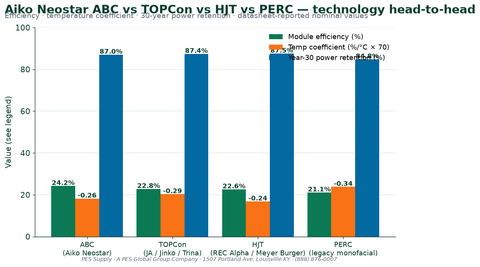
| N-TOPCon (Tiger Neo / TOPBiHiKu7) | n-type mono | 22.5 % | -0.29 to -0.30 %/°C | 87.4 % |
| Mono-PERC bifacial (HiKu6) | p-type mono | 21.1 % | -0.34 %/°C | 84.0 % |
| Spec | Jinko Tiger Neo 585W (JKM585N-72HL4M-BDVP) | Canadian TOPBiHiKu7 700W (CS7N-700TB) | Canadian HiKu 545W (CS6W-545) |
|---|---|---|---|
| Rated power (peak) | 585 W (580 / 585 / 590 / 595 / 600 W) | 700 W (690 / 695 / 700 W) | 545 W (540 / 545 / 550 W) |
| Cell technology | N-TOPCon | N-TOPCon | Mono-PERC |
| Cell format | 144 half-cells | 132 third-cell | 144 half-cells |
| Module efficiency | 22.65 % | 22.5 % | 21.1 % |
| Voc @ STC | 52.15 V | 44.30 V | 49.6 V |
| Isc @ STC | 14.28 A | 20.35 A | 13.95 A |
| Max system voltage | 1500 V DC (UL) | 1500 V DC (UL) | 1500 V DC (UL) |
| Temp coef Pmax | −0.29 %/°C | −0.30 %/°C | −0.34 %/°C |
| Bifaciality factor | 80 % | 80 % | 70 % |
| Product warranty | 12 yr (25 with reg.) | 15 yr | 12 yr |
| Performance warranty | 30 yr @ 87.4 % | 30 yr @ 87.4 % | 25 yr @ 84.0 % |
| 1st-yr degradation | 1.0 % | 1.0 % | 2.0 % |
| Linear degradation | 0.4 %/yr | 0.4 %/yr | 0.55 %/yr |
| Dimensions | 2465 × 1134 mm | 2384 × 1303 mm | 2261 × 1134 mm |
| Weight | 32.4 kg | 38.9 kg | 27.5 kg |
| Backsheet / rear | Glass (bifacial) | Glass (bifacial) | Glass (bifacial) |
| Connector | MC4 EVO2 | MC4 EVO2 | MC4 EVO2 |
| US assembly | Jacksonville, FL (2 GW online 2024) | Mesquite, TX (5 GW online 2025) | Ontario CAN + Mesquite TX |
Canadian TOPBiHiKu7 Isc is 20.35 A — above many combiner and fuse ratings.
The TOPBiHiKu7's 132 third-cell design pushes short-circuit current to 20.35 A — well above the 15 A ratings on many legacy combiner fuses and DC disconnects. When speccing TOPBiHiKu7, verify combiner fuse ratings (25 A or higher recommended), string cable ampacity (10 AWG PV wire minimum), and inverter DC input current limits. String inverters designed for legacy PERC (13-14 A Isc) can undersize their input protection for this module. Check the datasheet of your inverter's DC combiner box before finalizing the BOM.
The chart at the top of this guide shows real-world module output vs cell temperature. In utility applications, cell temperature routinely hits 55-65°C at midday summer conditions — even higher on desert projects. On a 5 MW-DC ground mount:
5 MW-DC ground mount, hot-climate desert conditions
- Jinko Tiger Neo 585W: 8,547 modules × 585W = 5.00 MW-DC. At 65°C cell temp, output derates by 11.6% (-0.29 %/°C × 40°C above STC) — real output ~4.42 MW-DC.
- Canadian TOPBiHiKu7 700W: 7,143 modules × 700W = 5.00 MW-DC. At 65°C, output derates by 12.0% — real output ~4.40 MW-DC. 1,400 fewer modules = ~15% less racking, ~15% less wiring labor.
- Canadian HiKu 545W (mono-PERC): 9,175 modules × 545W = 5.00 MW-DC. At 65°C, output derates by 13.6% — real output ~4.32 MW-DC. 20% more modules than TOPBiHiKu7 = more racking + labor + O&M.
TOPBiHiKu7 delivers the lowest module count per MW-DC and the best real-world hot-climate output — the volume choice for new utility builds. HiKu remains the cost-optimized value tier where hold horizons are under 15 years or the site is a cool climate.
Utility-scale projects almost always require BABA compliance or IRA §48 domestic-content bonus eligibility. Both brands have significant US assembly capacity:
| Brand | US assembly site | BABA / DAM status | IRA §48 module bonus |
|---|---|---|---|
| Jinko Solar | Jacksonville, FL (2 GW online 2024) | DAM (module assembly) | Eligible on JKM585N-US SKU |
| Canadian Solar | Mesquite, TX (5 GW online 2025) | DAM (module assembly) | Eligible on CS7N-700TB-US SKU |
Cell content note. Neither Jinko nor Canadian currently manufactures the underlying silicon cell in the US. That means module-assembly DAM is available, but full BABA compliance (including cell content) is not — a compliance letter typically says "domestic module assembly, imported cell" and qualifies for the §48 module-assembly bonus but not the full stack. Both brands have announced US cell facilities scheduled for 2027 online.
Tracker torque tube — TOPBiHiKu7 is heavier (38.9 kg) and needs stronger tube specs.
Canadian TOPBiHiKu7 700W = 38.9 kg on 2384×1303 mm — 18% heavier than Jinko Tiger Neo 585W (32.4 kg). On single-axis trackers (Nextracker NX Horizon, Array Technologies OmniTrack), verify the torque tube gauge and post spacing spec against the heavier module. Trackers designed for the 545W HiKu6 generation may need re-engineering.
Fixed-tilt racking — GameChange, RBI Solar, Solar FlexRack.
All three brands are on the approved-module lists for GameChange Solar Genius, RBI Solar Portrait GM, and Solar FlexRack TDP 2.0. Verify the exact SKU code — utility racking systems require the module dimensions and clamping-zone data sheet before mechanical engineering.
Ballast on flat-roof commercial — TOPBiHiKu7 is designed for ground mount.
The TOPBiHiKu7's 132 third-cell format and 20.35 A Isc are optimized for utility DC combiner architectures. On a flat-roof commercial with a residential-class inverter (Sol-Ark 30K-3P, SolarEdge SE100K), spec the Tiger Neo 585W or HiKu6 545W instead — the Isc matches these inverters' DC input.
Rapid shutdown — utility exempt in most cases.
Ground-mount PV over 100 kW-DC is generally NEC 690.12 exempt (2020+ NEC, ground array > 8ft from building). Rooftop C&I applications need module-level RSD — pair with Tigo TS4-A-F, APsmart RSD-S/D, or step to microinverters (Enphase IQ8P — verify Isc; TOPBiHiKu7 exceeds Enphase's current max input).
Bifacial gain — 80 % factor on both flagships.
Both Tiger Neo and TOPBiHiKu7 carry 80% bifaciality. On a ground-mount with light-albedo ground surface (concrete, painted white gravel, or a re-vegetated site with albedo 0.3-0.5), expect 10-18% bifacial gain at typical 4-6 ft mounting heights. Bifacial gain is highly site-specific — use the PES Solar System Calculator for a site-specific yield estimate.
| Application | Recommended brand | Why |
|---|---|---|
| Utility ground mount, single-axis tracker, > 1 MW-DC | Jinko Tiger Neo 585W or Canadian TOPBiHiKu7 700W | N-TOPCon, 30-yr warranty, DAM eligible. |
| Utility fixed-tilt, cost-sensitive, < 500 kW-DC | Canadian HiKu 545W | Mono-PERC bifacial, lowest $/W. |
| Commercial rooftop C&I, 100-500 kW-DC | Jinko Tiger Neo 585W | Lower Isc (14.3 A) matches standard C&I combiner ratings. |
| IRA §48 domestic content required | Jinko Tiger Neo US-DAM or Canadian TOPBiHiKu7 US-DAM | Both stamps qualify for §48 module bonus. |
| Hot-climate desert site | Jinko Tiger Neo 585W or Canadian TOPBiHiKu7 700W | -0.29 to -0.30 %/°C — best temperature performance. |
| EPC 25-yr PPA / debt-financed | Jinko Tiger Neo or TOPBiHiKu7 | 30-yr performance warranty backs the revenue model. |
Every SKU below is stocked in the PES Louisville warehouse or on a bonded pipeline PO. Prices shown are public retail; verified contractor accounts see 5–22% off list at Tier 1 – Tier 3. Freight is quoted at checkout.


Every SKU below is stocked in the PES Louisville warehouse or on a bonded pipeline PO. Prices shown are public retail; verified contractor accounts see 5–22% off list at Tier 1 – Tier 3. Freight is quoted at checkout.


Step 1 — Fix the peak wattage need.
Need to hit >5 MW-DC on a footprint-constrained site? Canadian TOPBiHiKu7 700W minimizes module count. Site is footprint-flexible? Jinko Tiger Neo 585W offers better cost per watt-DC.
Step 2 — Verify inverter and combiner amperage against Isc.
TOPBiHiKu7 Isc = 20.35 A. Legacy 15 A combiner fuses and DC disconnects are undersized — plan for 25-30 A ratings. Tiger Neo Isc = 14.28 A — standard combiner ratings work.
Step 3 — Confirm DAM requirement.
Both brands offer DAM SKUs (Jinko Jacksonville FL, Canadian Mesquite TX). Verify the -US suffix on the datasheet and the DAM stamp on the crate bill of lading.
Step 4 — Match to tracker or fixed-tilt racking spec.
TOPBiHiKu7 at 38.9 kg needs stronger torque tubes and post spacing than 32.4 kg Tiger Neo. Pull the racking-vendor structural sheet before finalizing.
Step 5 — Run the cost per watt-DC delivered to Louisville.
Tier 3 pallet-quantity contractor pricing at PES: Tiger Neo ~$0.24/W-DC, TOPBiHiKu7 ~$0.22/W-DC (larger pallets, better $/module), HiKu6 mono-PERC ~$0.19/W-DC. Freight is quoted at checkout — use the PES Freight Calculator for LTL/FTL by ZIP.
Which utility-scale panel is best — Jinko Tiger Neo or Canadian TOPBiHiKu7?
For a footprint-constrained site or a fewer-modules-per-MW build, Canadian TOPBiHiKu7 700W wins — 132 third-cell design, 20.35 A Isc, 22.5% efficiency, 30-yr @ 87.4% warranty. For a cost-optimized site or an EPC using standard 15 A combiner ratings, Jinko Tiger Neo 585W wins — 22.65% efficiency, 14.28 A Isc, 30-yr @ 87.4%. Both offer US-DAM SKUs for IRA §48 domestic-content bonus.
What is N-TOPCon and why is it the 2026 utility default?
N-TOPCon (Tunnel Oxide Passivated Contact on N-type wafer) is a cell architecture where a thin passivated tunnel-oxide layer at the rear surface cuts recombination losses to near-zero. Combined with an N-type wafer (eliminates LID losses of P-type), it delivers a 0.5-1.0% efficiency advantage over PERC and a materially better temperature coefficient (-0.29 to -0.30 %/°C vs -0.34 %/°C). On utility-scale projects that translates to fewer modules per MW-DC, less racking, less wiring, and more year-1 revenue.
Is Jinko Tiger Neo BABA-compliant for federally-funded projects?
Partial — the Jinko Solar Jacksonville, FL facility (2 GW online 2024) qualifies for the IRA §48 domestic-content module-assembly bonus with the -US SKU suffix. Cell content is still imported (US cell facility on 2027 roadmap). Compliance letters typically read "domestic module assembly, imported cell" — enough for the §48 module bonus but not the full BABA stack yet.
Is Canadian TOPBiHiKu7 BABA-compliant?
Same status as Jinko — the Canadian Solar Mesquite, TX facility (5 GW online 2025) qualifies for the IRA §48 domestic-content bonus on module assembly with the CS7N-700TB-US SKU. Cell content is imported. Full BABA including cell content is on Canadian's 2027 roadmap.
What temperature coefficient should I design for a Louisville or Phoenix utility site?
Utility-scale ground mount routinely runs cell temperatures of 55-65°C at midday summer. At -0.30 %/°C (Tiger Neo / TOPBiHiKu7), that's a 12% derating from STC — recoverable via better inverter DC/AC sizing and MPPT tracking. At -0.34 %/°C (HiKu6 PERC), it's 13.6% derating. On a 5 MW-DC Phoenix project the 1.6% delta is ~80 kW of continuous midday output — meaningful on a 25-yr PPA.
What warranty comes standard on Tiger Neo and TOPBiHiKu7?
Jinko Tiger Neo: 12-yr product (extended to 25 with online registration), 30-yr performance @ 87.4%. Canadian TOPBiHiKu7: 15-yr product, 30-yr performance @ 87.4%. Canadian HiKu6 (mono-PERC): 12-yr product, 25-yr performance @ 84.0%. All warranties require online registration inside 90 days of commissioning — PES auto-registers eligible warranties for verified contractor accounts.
How many utility panels fit on a freight pallet?
Jinko Tiger Neo 585W — 36 modules/pallet (~2,600 lb gross). Canadian TOPBiHiKu7 700W — 27 modules/pallet (~2,350 lb; larger footprint). Canadian HiKu6 545W — 31 modules/pallet (~1,900 lb). PES ships utility POs by FTL for pallet counts of 26+ pallets; below 26 the LTL rate is quoted at checkout. Use the PES Freight Calculator.
Are these panels compatible with SolarEdge or Enphase for C&I rooftop?
Jinko Tiger Neo 585W (Isc 14.28 A) is on SolarEdge S-series / P-series and Enphase IQ8P (16 A max input) compatibility lists. Canadian TOPBiHiKu7 (Isc 20.35 A) exceeds the standard input of most residential/C&I MLPE — string-inverter architecture (Sol-Ark 30K-3P, SolarEdge SE100K, Sungrow SG60CX-US) is the standard pairing. Verify on the PES Compatibility Checker.
What's the difference between HiKu6, HiKu7, and TOPBiHiKu7?
HiKu6 = mono-PERC bifacial 545W generation (2022-current, cost-optimized). HiKu7 = N-TOPCon 660-680W generation (2023+ utility, discontinued in favor of TOPBiHiKu7). TOPBiHiKu7 = current N-TOPCon 690-700W flagship with 132 third-cell design. HiKu6 remains in production for value tier; TOPBiHiKu7 is the premium new-build spec.
Do utility ground-mount panels need module-level rapid shutdown?
Ground-mount PV > 100 kW-DC and > 8 ft from any building is generally exempt from NEC 690.12 module-level RSD requirements (2020+ NEC, ground-array exemption). Rooftop C&I applications and building-adjacent ground arrays still require RSD — pair with Tigo TS4-A-F, APsmart RSD-S/D, or Fortress RSD. Always confirm with the local AHJ.
What's the cost per watt-DC delivered to Louisville for utility-scale?
Tier 3 pallet-quantity contractor pricing at PES: Jinko Tiger Neo ~$0.24/W-DC delivered to Louisville. Canadian TOPBiHiKu7 ~$0.22/W-DC. Canadian HiKu6 mono-PERC ~$0.19/W-DC. LTL freight adds $0.01-0.02/W depending on ZIP and pallet count; FTL for 26+ pallets is typically $0.005-0.01/W. Use the PES Freight Calculator for a live rate.
Does PES offer EPC pricing on Jinko and Canadian utility panels?
Yes — Tier 3 EPC pricing (12-22% off list + custom freight) applies to full-pallet and full-container POs on both brands. EPC terms are case-by-case: Net-30, Net-45, or Net-60 depending on credit review. Register the corporate EIN + resale + trade references at axis.pesdistribution.com/portal-registration.
Open a PES Supply contractor account
Direct-distributor pricing on the full PES Supply solar panel catalog — LONGi, Aiko, JA Solar, Jinko, REC, Silfab, Bluesun, Trina, Canadian Solar, SunPower. Louisville-warehoused, pallet-freight quoted at checkout. Registered contractors also get the PES portal String Sizing, Compatibility, and Freight calculators — cross-links to the Solar Inverter Distributor Hub and the Racking & Mounting Hub live inside the portal.
Register for contractor pricing