Microgrid Integration with Commercial BESS: Grid-Forming Design and Revenue
How a commercial battery becomes a microgrid node — grid-forming vs grid-following PCS, dispatch controllers, black-start capability, and the resiliency-plus-revenue stack that changes BESS from a peak-shave tool into an operating asset.

The terminology matters here. A commercial site with a BESS providing 4 hours of backup power during a grid outage is not, strictly, a microgrid — it is a battery with an automatic transfer switch. A microgrid is a system that can operate indefinitely in island mode, sustained by on-site generation, with the BESS providing the grid-forming reference that lets the rest of the DERs on-site (solar PV, natural gas genset, EV chargers) participate.
The distinction has practical consequences. A backup BESS runs for 4 hours and then dies. A microgrid runs indefinitely because solar recharges the battery, and the natural-gas genset (if present) provides overnight bridge power. The system controller — a microgrid controller or "microgrid EMS" — dispatches assets according to economic and resiliency objectives.
For a cold-storage warehouse in Pennsylvania, a backup BESS handles a 2-hour utility outage and buys time for the on-call refrigeration tech. A microgrid handles a 4-day ice storm that takes down the utility for 96 hours, keeping the ammonia refrigeration system running through solar-charged battery and overnight genset bridge. The economic difference — $150,000 in spoiled product avoided per event — is what drives the microgrid decision.
The rest of this guide walks through the architecture — grid-forming PCS, controllers, integration with solar and generation, and the sites where microgrids actually pencil.
Every PCS on the market operates in one of two modes:
Grid-following (GFL) — the PCS reads the utility's voltage and frequency reference and injects power synchronized to it. If the utility disappears, GFL disconnects (anti-islanding, per IEEE 1547). GFL is the default for utility-scale storage and most C&I peak-shave BESS. It cannot form its own grid.
Grid-forming (GFM) — the PCS generates its own voltage and frequency reference and can operate without a utility reference. When the utility fails, the GFM PCS transitions to island mode and other DERs on the site (solar PV, genset) follow the GFM reference. GFM is required for any true microgrid architecture.
Not every PCS supports GFM. In the C&I band:
- Sol-Ark 15K-2P and 30K-3P — GFM native. Excellent for microgrid deployments in the 15–90 kW range with parallel stacking.
- EG4 18kPV — GFM native. Good for microgrid deployments in the 15–75 kW range.
- Schneider XW+ 6848 and XW Pro — GFM native. Long-standing microgrid PCS with a mature dealer ecosystem.
- Sungrow SG250HX — GFM via firmware option. Common in containerized 500 kWh–2 MWh systems.
- EPC Power CAB 1000 — GFM native, purpose-built for utility-scale and microgrid deployments.
- SMA Sunny Central Storage 1900-SC / 2500-SC — GFM available but less common in C&I.
PCS PES ships for microgrid deployments are all GFM-capable. Specifying a GFL-only PCS on a microgrid project is a project killer — the design goes back to square one when the microgrid controller manufacturer confirms the PCS won't island.
A microgrid needs a controller — a real-time supervisory system that dispatches the BESS, solar PV, genset, and loads according to economic and resiliency objectives. Without a controller, the BESS is just a big battery with a manual transfer switch.
Controllers span a wide range:
- Basic supervisory controller — a PLC or embedded system that handles automatic transfer, SOC management, and dispatch of a single genset. Adequate for simple resiliency deployments. Cost $8,000–$25,000.
- Distributed energy resource management system (DERMS) — a full software platform that manages multiple DERs, integrates with utility DR programs, optimizes dispatch for economics, and provides customer-facing dashboards. Cost $35,000–$120,000 depending on scope. Examples: PXiSE (part of Yokogawa), Schweitzer Engineering SEL RTAC + platform, Emerson Ovation, ABB Ability, Siemens SICAM.
- Cloud-based EMS — Software-as-a-Service platforms that manage the microgrid from the cloud with edge controllers on-site. Examples: Ampcontrol, Nordic Elektroaggregate, VoltusEdge, XENDEE. Cost typically $500–$2,500/month subscription.
For a typical C&I microgrid in the 500 kW / 2 MWh band with solar and a small genset, a DERMS with a cloud dashboard is the standard. Total controller cost $35K–$60K one-time plus $600–$1,800/month for cloud services. This appears in the BESS project scope as a controls line item.
PES coordinates the controller selection with the PCS and BESS during design, so the interfaces (Modbus TCP, DNP3, OpenADR 2.0b) are pre-configured at commissioning.
| Site Type | Typical Load Profile | Recommended BESS | Generation Mix | Controller |
|---|---|---|---|---|
| Cold storage warehouse | 150–400 kW continuous, seasonal peak | 500–1000 kWh, GFM PCS | 300–600 kW PV, natural gas genset bridge | DERMS with load-priority dispatch |
| Cannabis grow facility | 500 kW–2 MW HID/LED cycled | 1–3 MWh, containerized GFM | 500–1500 kW PV, propane genset backup | DERMS with lighting-cycle awareness |
| Tier-3 data center | 200 kW–1 MW UPS-supported | 500 kWh–2 MWh, redundant GFM | Rooftop PV, diesel backup, redundant utility | SEL RTAC + DERMS platform |
| Class-8 truck depot | 50–500 kW EV charging bursts | 500 kWh–2 MWh, GFM with fast response | Rooftop or ground-mount PV, no genset | Cloud EMS with charger scheduling |
| Municipal shelter | 20–75 kW essential loads | 100–250 kWh, GFM PCS | 50–150 kW PV, propane genset | Basic supervisory controller |
| Cannabis extraction facility | 150–350 kW process-critical | 500–1000 kWh, GFM containerized | Rooftop PV, natural gas genset | DERMS with process-lock logic |
| Small hospital / clinic | 100–500 kW critical loads | 500 kWh–1 MWh, hospital-grade GFM | Rooftop PV, diesel Level 1 emergency genset | SEL RTAC with hospital fire panel integration |
"Black start" is the ability of the microgrid to energize from a completely de-energized state — no utility, no running genset, everything cold. The BESS with GFM PCS provides the initial voltage and frequency reference, and then the rest of the system (solar inverters, genset) synchronizes to that reference.
Black start is not the same as automatic transfer. Automatic transfer means the system detects utility loss and switches — the transfer typically involves a brief interruption (200–500 ms) that the BESS/PCS handles. Black start means starting from zero: the utility has been out for hours, the genset has run out of fuel, the battery has cycled deeply, and now the utility comes back and everything has to re-synchronize.
Practical implications:
- All GFM PCS PES stocks support black start.
- The BESS needs to hold a "black start reserve" — typically 10–20% SOC — that is not dispatched for peak shaving or DR.
- The controller sequences the black-start procedure: BESS energizes site bus, solar PV inverters come online in sequence (they must follow the BESS reference), genset starts if fuel is available.
- For critical loads (medical, refrigeration, telecom), black start is an insurance requirement. For most C&I sites, it's a nice-to-have that gets exercised once a year during maintenance.
-
1
Confirm the resiliency objective in operating hours.
Cold-storage ammonia refrigeration needs to run continuously — a 4-hour outage costs $12,000 in spoiled product; a 24-hour outage costs $80,000. Target: 96-hour resiliency for a major storm event.
-
2
Model the essential load profile.
Full-site load 380 kW; essential load (refrigeration + minimum lighting + controls) is 210 kW. Microgrid designs to the essential load, not the full-site load. The 170 kW of non-essential load stays offline during islanded operation.
-
3
Size the BESS for the deepest solar-off-day.
For 96-hour resiliency with 400 kW of solar PV on the roof, the BESS handles: overnight load (12 hours × 210 kW = 2.5 MWh) minus overnight solar (0) = 2.5 MWh overnight. If a genset is present, the BESS handles 6–8 hours of overnight bridge, then genset takes over. This drives BESS to 2 MWh (4 hours at 500 kW discharge, plus buffer).
-
4
Specify GFM PCS with black-start capability.
500 kW containerized system with Sungrow SG250HX in GFM mode, or two 250 kW Sol-Ark 30K-3P stacked in parallel. Confirm GFM firmware and black-start capability with the manufacturer before PO.
-
5
Integrate the solar PV inverters to follow the BESS reference.
Existing 400 kW solar PV must have GFL inverters that will follow the BESS-formed reference during islanding. Most SolarEdge, Enphase (with Sunlight Backup), and Fronius inverters support this. Verify firmware version and configuration.
-
6
Add a 200 kW natural-gas genset for bridge.
For 96-hour resiliency in a Pennsylvania winter, natural gas is more reliable than diesel (no fuel storage limit, utility supply generally maintained during storms). 200 kW genset covers overnight essential load and recharges the BESS during off-peak. Diesel is used only where natural gas is unavailable.
-
7
Deploy a DERMS with load-priority dispatch.
DERMS runs the economic dispatch: BESS handles peak shaving and DR during normal grid-connected operation. On islanding, DERMS switches to resiliency mode — BESS forms grid, PV follows, genset starts when SOC drops below 40%, load management sheds non-essential circuits.
-
8
Configure DR participation for the grid-connected mode.
During normal operation, the microgrid participates in PJM Capacity Performance and emergency DR. During islanded operation, DR is disabled. DERMS handles the mode transition.
-
9
Test the microgrid quarterly.
Every 90 days, run a full-site test: manually trigger islanding, verify BESS forms grid, PV synchronizes, genset starts, load management sheds correctly. Restore to grid-connected, verify re-synchronization. Document the test in the DERMS log.
A microgrid operates in grid-connected mode 99%+ of the year. During grid-connected operation, the microgrid captures the full commercial BESS revenue stack: peak shaving, DR capacity, energy arbitrage, and ancillary services. The microgrid controller ensures these operations do not compromise the resiliency reserve.
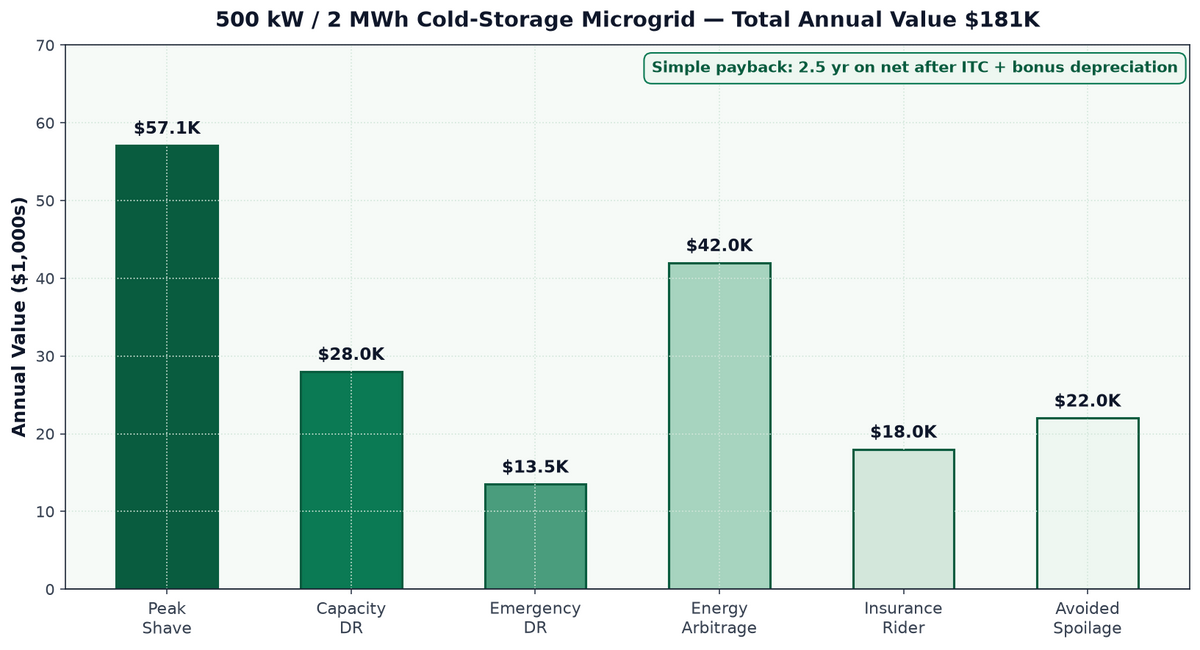
For the cold-storage warehouse example above (500 kW / 2 MWh) in PJM Zone A:
Grid-Connected Revenue — 500 kW / 2 MWh Microgrid
- Peak shaving 170 kW × $28 × 12 = $57,120/yr (larger than a standalone BESS because microgrid can shave to essential load)
- PJM Capacity Performance 400 kW × $70 = $28,000/yr
- PJM emergency DR 25 events × 400 kW × 3 hr × $450/MWh = $13,500/yr
- Energy arbitrage 200 cycles × 1.5 MWh × $0.14 = $42,000/yr (larger spread available in strong-arbitrage markets)
- Insurance premium reduction (business interruption + property) = $18,000/yr (typical 10–15% reduction on a certified microgrid)
- Avoided spoilage cost (statistical avoided-loss valuation): $22,000/yr
Total annual value: $180,620/yr. System capex $1,020,000 installed. Net after ITC + adders + bonus depreciation: ~$460,000. Simple payback on net: 2.5 years.
The insurance line matters. Cold-storage carriers, cannabis-specific carriers (CannGen, MJ Coverage, etc.), and hospital/medical carriers all offer premium reductions of 10–15% on business interruption and property coverage when the site has a certified microgrid with automatic fail-over. The reduction has to be underwritten specifically; the customer requests the microgrid rider at annual renewal.
Solar PV pairs naturally with BESS in a microgrid architecture. The PV inverters supply energy during daylight (used directly by loads or stored in the battery); the battery supplies energy during peak hours and off-solar hours. During islanded operation, PV follows the BESS-formed reference and extends the resiliency window.
Three architectural choices:
- AC-coupled BTM — PV and BESS each connect to the customer's AC bus separately, coordinated by the microgrid controller. Highest flexibility, most common in retrofit deployments where PV was already installed.
- DC-coupled BTM — PV and BESS share a common DC bus feeding a single hybrid PCS. Higher round-trip efficiency (fewer DC/AC/DC conversions) and simpler controls, but requires new inverter selection. Common in ground-up new-build microgrids.
- Front-of-meter PV + BTM BESS — PV exports to the utility grid via a separate meter (typically for a NEM credit), BESS operates behind the meter for peak shave and DR. Common when the site has excess roof capacity and wants to monetize the PV via NEM rather than self-consumption.
For microgrid designs, DC-coupled is often the cleanest architecture. Sol-Ark 30K-3P DC-couples to PV strings up to 45 kW per unit; multiple units stack in parallel to 200+ kW. Sungrow and EPC Power containerized systems offer DC-coupled configurations up to 1.25 MW.
A microgrid adds cost and complexity vs a standalone BESS: additional PCS spec (GFM), controller ($35K–$60K), coordination with existing solar inverters, and ongoing DERMS subscription. The cost premium is $80K–$180K on a 500 kW / 2 MWh project. This premium is only justified where the resiliency and integrated-revenue benefits outweigh it.
Sites where the math works consistently:
- Cold storage, food processing, cannabis — spoilage value is the differentiator; a single 24-hour outage can cost more than the microgrid premium.
- Small-to-mid data centers (Tier 2–3) — uptime SLA drives the resiliency requirement; utility outages that exceed generator run time are unacceptable.
- Class-8 truck depots and DC fleet charging — EV charging demand spikes are massive; microgrid handles the spikes and smooths grid impact.
- Cannabis extraction and processing — process-lock requirements (once a batch starts, it must complete) make outages very expensive.
- Hospitals, clinics, and dialysis centers — life-safety loads plus economic loads; microgrid extends beyond code-required emergency backup.
- Rural telecom central offices and cell sites — long fiber runs mean utility restoration can take days; solar+BESS+genset microgrid runs indefinitely.
- Universities and K-12 shelter facilities — public safety mandate for storm response; microgrid enables the campus to serve as community shelter.
Sites where a standalone BESS is more economical than a microgrid:
- Office buildings and retail — outage cost is low; peak-shave BESS alone captures most of the value.
- Multifamily housing — building code emergency backup requirements are separate; microgrid is not the natural fit.
- Sites without on-site solar PV or genset — microgrid without generation is just a bigger battery.
DERMS platforms vary widely in capability and price. When selecting for a C&I microgrid, the features that actually matter:
Real-time dispatch and control — the platform must communicate with the BESS, solar inverters, genset, and load-management devices in real time (sub-second for grid-forming coordination, seconds for economic dispatch). Modbus TCP, DNP3, and OpenADR 2.0b are the baseline protocols.
Economic dispatch optimization — the platform runs an optimization model (linear or mixed-integer programming) to determine when to charge, discharge, export, or reserve the battery based on tariff, market prices, weather forecast, load forecast, and reserve requirements. Basic controllers dispatch on rules; advanced DERMS run true optimization.
Weather and load forecasting — 24- to 48-hour forecasts of solar generation and site load, updated hourly. The forecast quality directly determines dispatch quality. Good DERMS integrate multiple weather sources (NOAA, Solcast, MeteoBlue) and use site-specific historical data.
DR aggregator integration — direct API integration with the aggregators the site is enrolled with. CPower, Voltus, and Enel X each have their own API; the DERMS should support the aggregators active in the site's ISO territory.
Customer dashboard — the customer-facing view. Should show real-time SOC, current dispatch mode, savings-to-date, DR event history, resilience status, and alert center. This is what the facility manager checks weekly.
Alerting and remote support — SMS/email/phone alerts on faults, thermal events, comm loss, or dispatch anomalies. Vendor-side monitoring for critical events with escalation paths.
Reporting — monthly savings reports, tax-credit documentation support, warranty performance tracking, cycle-life monitoring.
DERMS platforms in the C&I microgrid band range from $500/month cloud-only (basic dispatch and dashboard) to $2,500/month (full optimization with weather integration and advanced reporting). On-premise DERMS with full customization (SEL RTAC, Emerson Ovation) run $60K–$150K upfront with limited ongoing fees.
During islanded operation, the microgrid runs off the BESS-formed reference plus solar and genset. Load must be balanced against generation, and this is where load management enters the design.
Two approaches:
Passive segregation — essential loads wired to a dedicated essential-load panel; non-essential loads on a separate panel that is de-energized during island mode. Simple, reliable, no software dependency. The essential-load design has to identify each circuit in advance and physically wire the panels correctly. Typical essential loads: refrigeration, medical equipment, minimum lighting, IT infrastructure, security, communications.
Active load management — smart contactors or load-side breakers with communication interfaces. DERMS can shed loads dynamically based on current SOC, forecast, or dispatch priority. More flexible but adds cost ($3K–$8K in additional contactors and $8K–$20K in DERMS integration).
For most C&I microgrids, a hybrid approach works best: passive segregation for the top-priority essential loads (refrigeration, medical, safety), plus 2–4 actively-managed circuits for mid-priority loads (lighting, some HVAC, non-critical office equipment).
Microgrid interconnection is more complex than a standalone BESS interconnection because the utility has to be assured the microgrid will not back-feed the grid during island mode and will re-synchronize safely on grid restoration.
Key utility requirements:
- Positive isolation during island mode — a break-before-make transfer switch or a certified grid-tie inverter with fast disconnect. Physical isolation is preferred by most utilities.
- Anti-islanding certification — the PCS must pass anti-islanding test per IEEE 1547 and UL 1741. Grid-forming PCS in microgrid mode intentionally violates this in the microgrid but reverts to compliant behavior at utility restoration.
- Grid-support functions — Volt-VAR, Volt-Watt, frequency-Watt as directed by the utility. Most modern PCS include these; older units may need firmware updates.
- SCADA / DERMS integration with utility — some utilities require real-time telemetry from the microgrid controller. Modbus or DNP3 typical.
- Re-synchronization procedure — automated with the PCS; documented in the interconnection agreement.
Interconnection process for microgrids typically takes 4–16 weeks depending on utility and system size. Systems <25 kW often clear fast-track. Systems 25–500 kW go through Level 2. Systems >500 kW go through Level 3 or full impact study, which is the timing-critical path on most large microgrid projects.
Commercial property and business-interruption carriers increasingly recognize microgrids as risk-reducers. Verifiable microgrid deployments qualify for premium reductions of 10–15% on business interruption and property coverage. The underwriting package that unlocks this:
- UL 9540 listing certificate and UL 9540A test data at the installation level.
- Emergency operations plan (EOP) per NFPA 855.
- Test-report record from the quarterly microgrid black-start test.
- DERMS access for carrier auditor review (read-only permissions typical).
- Redundancy documentation — dual utility feeds, redundant PCS, spare battery modules.
- Continuous monitoring evidence — 24/7 cloud dashboard with alert paths, response-time commitments.
- Personnel training records — site personnel trained on emergency shutdown, first-responder coordination, event response.
The underwriting package is put together at the annual policy renewal, not at BESS commissioning. PES supplies the technical documentation; the customer's insurance broker coordinates with the carrier's engineering group. On sites where the business-interruption premium is material (cold storage, cannabis, medical), the annual premium reduction typically ranges from $8,000 to $35,000 — a real line item in the microgrid pro forma.
Multi-site customers (retail chains, cold-storage networks, cannabis operators, university systems, telecom carriers, quick-service restaurant chains) increasingly deploy microgrids across their portfolio. The economics change when moving from single-site to portfolio:
- Volume equipment pricing — 10-site deployments unlock roughly 8–15% additional equipment discount vs single-site.
- Standardized designs — repeatable specs across sites cut engineering hours by 40–60%.
- Centralized DERMS — one DERMS platform managing 10 sites is more economical than 10 separate platforms; unified reporting and cross-site optimization (e.g., dispatch coordination during grid stress).
- Fleet DR bidding — aggregated capacity across sites can enter markets that individual sites cannot (e.g., PJM Capacity Performance requires minimum bid size that a single site rarely meets, but 10 sites easily meet).
- Portfolio-level ITC and financing — sale-leaseback and PPA structures work best at portfolio scale where tax-equity investors are willing to underwrite a $10M+ tranche.
PES supports multi-site portfolio deployments through a portfolio-level distributor account, standardized equipment stack across sites, and coordinated commissioning with a single project-management contact. Ask about portfolio pricing during the first-site engagement — the value shows up on sites 3+ and compounds through site 10.
A representative project that walks through the full design and economic case: a 500 kW / 2 MWh microgrid at a mid-sized cold-storage warehouse in Pennsylvania.
Site profile: 45,000 sq ft cold storage, ammonia refrigeration, 380 kW peak load, 180 kW average. Customer holds $8M+ in frozen inventory at any time. Historical utility outages: 3 events in the past 5 years, each 2–8 hours; one 26-hour outage during a 2022 storm cost approximately $180,000 in spoiled product.
Design objectives:
- Peak-shave 100 kW during summer months on a PJM Zone A NCP tariff at $28/kW-mo.
- Provide 72-hour resiliency for essential loads (refrigeration, controls, minimum lighting) during utility outages.
- Participate in PJM Capacity Performance and emergency DR.
- Meet AHJ requirements without site expansion (existing footprint constraints).
Equipment selection:
- 500 kW / 2 MWh containerized BESS (20-ft ISO container, LFP, containerized OEM system).
- Sungrow SG500HX in grid-forming mode as the PCS.
- Existing 400 kW rooftop solar PV, SolarEdge inverters, upgraded firmware for GFM-follow.
- Existing 300 kW natural-gas genset (backup for compressor start bank), integrated to microgrid controller.
- DERMS from cloud vendor with load-priority dispatch and hospital-fire-panel-compatible interface.
- Site controller in NEMA 4X cabinet with cellular backhaul.
Financial results (year 1 annualized):
- Total installed cost: $1,020,000.
- ITC 30% + 10% domestic + 10% energy community = $510,000.
- Bonus depreciation NPV: $50,000.
- Net installed cost: $460,000.
- Annual revenue stack: $180K (peak shave $57K, capacity DR $28K, emergency DR $14K, arbitrage $42K, insurance premium reduction $18K, avoided spoilage $22K).
- Simple payback on net: 2.5 years.
- 10-year net revenue: $1,340,000 vs $460,000 net cost = $880,000 net profit.
The project cleared the AHJ in a 6-week plan review with an installation-level UL 9540A report and a template EOP. Site prep took 8 weeks (concurrent with equipment lead time). Delivery and commissioning: 5 business days. Total elapsed from PO to PTO: 18 weeks.
Can an existing solar+BESS installation be upgraded to a microgrid?
Do all microgrids need a genset?
What's the difference between a microgrid controller and a BMS?
Can a microgrid island automatically or does it need a person to initiate?
How much does the microgrid controller subscription cost?
Does the microgrid need to be UL 9540 listed?
What happens to the microgrid when the utility comes back after an outage?
Design a Commercial Microgrid With Grid-Forming BESS
PES specifies GFM-capable PCS, containerized BESS, and DERMS controllers as an integrated package — with PV integration, genset coordination, and DR aggregator setup handled in one project scope.
Register Now