Containerized BESS Selection for Commercial Sites: 500 kWh to 5 MWh
How to spec, site, and freight a containerized battery energy storage system — ISO footprint, HVAC, PCS integration, transformer sizing, and the site-prep checklist that decides whether the container drops in one day or three weeks.

At 100–500 kWh, a battery energy storage system is a wall-mount stack or a floor-mount cabinet delivered on standard pallets. Fortress Avalon HV Pro Business, BYD Battery-Box HVM Commercial, and Pytes V5α racks all fit this profile — pre-integrated inside their enclosures, but installed piece by piece and wired up on site by an electrical contractor.
Above 500 kWh, the economics shift decisively toward containerized systems: the entire BESS — battery racks, PCS, HVAC, fire suppression, monitoring, controls — is factory-integrated inside a 10-ft, 20-ft, or 40-ft ISO container (or an equivalent walk-in enclosure). The container ships on a flatbed, gets set on a slab, gets connected to a transformer and a controls network, and is commissioned within 2–5 days.
The tradeoff — containerized systems are less flexible than a rack-and-cabinet build. You cannot easily add another 100 kWh in year 3; the enclosure is sized to the initial order. In exchange, you get:
- Factory integration — the PCS, battery, HVAC, and fire suppression have been tested together and shipped as a listed system.
- UL 9540A installation-level test data — the fire test was run on the actual container configuration.
- Compressed install schedule — 2–5 days to commissioning vs 2–4 weeks for a rack-and-cabinet build.
- Lower $/kWh — factory integration and volume shipping bring landed cost to roughly $380–$460/kWh for 1–5 MWh systems.
- Weatherized enclosure — NEMA 3R or 4X for outdoor exposure without a building.
Containerized BESS ship in three standard sizes plus custom builds. Each has a specific footprint, weight, and freight profile:
10-ft container / walk-in enclosure (500–750 kWh) — Approximately 10 ft L × 8 ft W × 8.5 ft H. Weight 12,000–18,000 lbs loaded. Ships on a standard flatbed, no oversize permit needed. Site slab minimum: 12 ft × 10 ft, 6" reinforced concrete, 3,000 psi. This is the entry-level containerized product; most 500 kWh commercial BESS from major manufacturers ship in this form.
20-ft container (1–1.5 MWh) — Approximately 20 ft L × 8 ft W × 8.5 ft H. Weight 28,000–42,000 lbs loaded. Ships on a standard flatbed or drop-deck trailer. Site slab minimum: 22 ft × 10 ft, 8" reinforced concrete, 3,500 psi. This is the workhorse size for mid-C&I projects — small data centers, cold storage, cannabis, metal-finishing.
40-ft container (2–3 MWh) — Approximately 40 ft L × 8 ft W × 9.5 ft H (high-cube). Weight 52,000–72,000 lbs loaded. Ships on a step-deck or lowboy trailer with an oversize permit in most states. Site slab minimum: 42 ft × 10 ft, 8" reinforced concrete, 3,500 psi. This is the largest single-container product and the most common configuration for BESS systems in the 2–3 MWh band.
Multi-container systems (3–5 MWh) — Multiple 20-ft or 40-ft containers with a dedicated skid-mounted PCS/transformer set. Typical layout is 2–4 battery containers plus 1 PCS container on a 60 ft × 40 ft pad. Feeds directly into a medium-voltage transformer (typically 480 V to 12.47 kV or 13.8 kV).
| Configuration | Nameplate | Footprint | Loaded Weight | Freight Class | Typical Lead Time |
|---|---|---|---|---|---|
| Walk-in enclosure | 500 kWh | 10' × 8' | 12–15 klb | Class 92.5 flatbed | 10–14 wk |
| Walk-in enclosure | 750 kWh | 12' × 8' | 16–19 klb | Class 92.5 flatbed | 10–14 wk |
| 20-ft ISO container | 1 MWh | 20' × 8' | 28–34 klb | Flatbed | 12–16 wk |
| 20-ft ISO container | 1.5 MWh | 20' × 8' | 36–42 klb | Flatbed | 12–18 wk |
| 40-ft ISO container | 2 MWh | 40' × 8' | 52–58 klb | Step-deck, oversize | 14–20 wk |
| 40-ft ISO container | 3 MWh | 40' × 8' | 64–72 klb | Step-deck, oversize | 16–22 wk |
| Multi-container | 5 MWh | 60' × 40' pad | 160–200 klb total | Multiple loads | 20–26 wk |
Every containerized BESS integrates a power conversion system (PCS) — the DC/AC inverter block that connects the battery to the site's AC bus. The PCS selection determines what the BESS can do and, more importantly, what markets it can participate in.
Grid-following PCS — the default for most containerized systems. Follows the utility voltage and frequency reference and injects real and reactive power. Works when the grid is present; disconnects when the grid fails. Suitable for peak shaving, DR, energy arbitrage, and ancillary services in front-of-meter markets. Examples: Sungrow SC1000UD/SC1250UD, EPC Power CAB 1000, SMA Sunny Central Storage 1900-SC.
Grid-forming PCS — creates its own voltage and frequency reference and can operate islanded when the grid fails. Required for microgrid architectures where the BESS provides the reference to solar PV inverters and other DERs during islanded operation. Examples: EPC Power CAB 1000 in grid-forming mode, Sungrow SG250HX in grid-forming mode (with firmware option), Tesla Powerhub, PowerElectronics FS1750K.
For most C&I containerized deployments (peak shave + DR), grid-following is sufficient and less expensive. For microgrid deployments (cold storage with backup, cannabis with resiliency, data center islanding, university campuses), grid-forming is required. The Microgrid Integration guide walks through the grid-forming decision in depth.
PCS power rating is separate from battery kWh. A 2 MWh battery can pair with a 500 kW PCS (4-hour discharge), a 1 MW PCS (2-hour discharge), or a 2 MW PCS (1-hour discharge). The pairing determines what markets the system can serve. Most C&I BESS ships as 4-hour duration (kW:kWh ratio of 1:4), which matches typical DR event durations and peak-shave requirements.
A well-prepared site allows a containerized BESS to move from delivery to commissioning in 2–5 days. A poorly-prepared site adds 2–4 weeks. The prep list is not complicated but has to be sequenced correctly:
- Slab poured, cured, and load-tested. Minimum 6" for 500–750 kWh systems, 8" for 1 MWh+, with #4 rebar at 12" O.C. each way. Concrete must reach 3,000–3,500 psi (typically 21 days cure). Slab must be within 1/4" of level across the footprint.
- Grounding grid installed and tested. Ground grid tied to the building electrical service ground, with a minimum of four ground rods and continuous #4/0 bare copper. Ground resistance target: <5 Ω.
- Underground conduits stubbed up to slab locations. AC power conduits sized for the PCS output, controls conduits for the SCADA/monitoring link, comms conduit for cellular/fiber. All stubbed 6" above finished slab and capped.
- Transformer installed and energized. For 1 MWh+ systems, a dedicated 480 V transformer is typically required — 750 kVA to 2,500 kVA depending on PCS rating. Coordinate with the utility if the transformer requires primary work.
- Fire lane and access clearance established. 20 ft engine-access lane, unobstructed, from the nearest fire hydrant to the BESS pad. Note on drawings and confirm with fire marshal.
- Site security and monitoring cameras installed. Not required by code in most jurisdictions but recommended by every insurance carrier writing BESS coverage. Minimum: perimeter fence, motion-activated cameras with cellular upload.
- Utility interconnection agreement executed. The interconnection permission has to be in hand before the BESS can be commissioned; without it, the PCS cannot legally connect to the grid.
- Crane and delivery access confirmed. Container placement typically uses a 40-ton crane with a 30-ft boom. Confirm crane access to the pad, overhead clearance (utility lines, tree canopy), and ground pressure limits.
-
1
Confirm the site's peak load and demand-charge exposure.
Pull 12 months of interval data. Cold-storage warehouse pulls 380 kW peak, average 180 kW, on a $28/kW-month NCP tariff — $10,640/month demand exposure. Target 80–100 kW peak shave, which sizes the BESS to 400 kWh (4-hour discharge at 100 kW).
-
2
Round up to the nearest standard containerized size.
400 kWh is below the standard 500 kWh containerized offering. Round up to 500 kWh / 125 kW PCS — one 10-ft walk-in enclosure or a compact 20-ft container. The incremental cost is small ($30–$45K) and the extra capacity supports DR revenue.
-
3
Verify site slab and access.
Walk the site with the containerized OEM's site-prep spec. Confirm slab can be added within 20 ft of the transformer, crane access is unobstructed, and fire lane can be established.
-
4
Confirm PCS compatibility with existing site controls.
If site has a BMS or SCADA (typical for cold storage), confirm the containerized system's controls will interface via Modbus TCP or BACnet IP. If site has no BMS, the containerized system's cloud dashboard is the primary interface.
-
5
Model revenue stack in the ROI calculator.
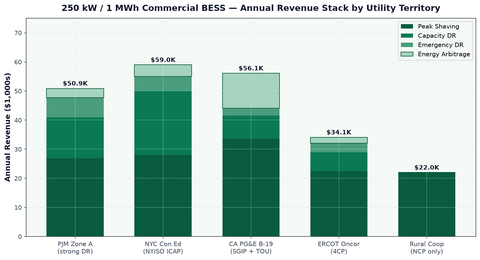
PJM Zone A: 100 kW peak shave × $28 × 12 = $33,600/yr. 125 kW DR capacity × $70 = $8,750/yr. 20 events × 3 hr × 125 kW × $450/MWh = $3,375/yr. Total revenue $45,725/yr. On $215,000 installed, 4.7 year simple payback gross, ~2.3 years after ITC and bonus.
-
6
Lock the PO with freight and commissioning bundled.
PES quotes containerized systems with landed freight (flatbed + oversize permit as needed), setback-appropriate UL 9540A test package, template EOP, and 2-day commissioning included. Single invoice line, no post-delivery surprises.
-
7
Coordinate the AHJ walk-through 30 days before delivery.
Walk the pad location with the fire marshal, review the emergency operations plan, and confirm the setback distances. This 30-minute meeting prevents 90% of plan-review holds.
-
8
Delivery, set, commission, energize in 5 days.
Day 1: crane delivery and set on slab. Day 2: electrical terminations (AC and DC), controls terminations, comms setup. Day 3: pre-energization checks, ground continuity, insulation resistance, communication verification. Day 4: utility witness test and PTO (permission to operate). Day 5: DR aggregator integration and revenue-mode activation.
Lithium iron phosphate cells operate optimally between 15°C and 35°C (59–95°F). Outside that window, cycle life degrades — every 10°C above the operating range roughly halves calendar life. In a Phoenix summer, an unmanaged container with 2 MWh of cells will hit 55°C internal temperature within days, and the warranty voids inside a year.
Containerized BESS ship with one of three thermal management approaches:
- Air-cooled HVAC — commercial rooftop split systems (typically 5–15 tons per 1 MWh container). Adequate for most climates; energy overhead runs 3–6% of throughput.
- Liquid-cooled modules — coolant loops directly through the battery modules with a chiller on the container roof. More efficient (energy overhead 1–3%) and used on higher-density units, especially 40-ft 3 MWh containers where air cooling can't keep up.
- Immersion cooling — cells submerged in dielectric coolant. Emerging; used on some 5 MWh utility-scale systems. Not typical in the C&I band yet.
The HVAC selection matters for site design because it adds electrical parasitic load (2–8 kW continuous for a 1 MWh air-cooled unit) and affects the setback distances (some HVAC condensers require rear clearance). Confirm the parasitic draw in the pro forma — a 5 kW continuous parasitic on a $0.09/kWh energy tariff costs $3,942/year, which is a meaningful line item.
Every containerized BESS above 250 kWh ships with integrated fire safety systems. The specific package varies by manufacturer but typically includes:
- Aerosol suppression — Stat-X, Fireaway, or equivalent condensed aerosol generators mounted at cell-rack level. Discharges automatically on smoke or thermal detection.
- Gas detection — hydrogen, CO, HF sensors on the ventilation intake, tied to the alarm system.
- Ventilation — active exhaust that runs continuously in some designs, event-triggered in others. Sized to clear evolved gas at the design case (typically 1 module in runaway).
- Deflagration panels — pressure-relief panels on the container ceiling or side wall that vent overpressure without projecting shrapnel. Required by NFPA 69 explosion prevention when the ventilation strategy is not sufficient.
- Alarm interface — dry contact or Modbus/BACnet output to the building fire panel, plus 24/7 cloud monitoring with SMS/email alerts.
These systems are integrated at the factory and tested as part of the UL 9540A installation-level fire test. The AHJ reviews the fire-safety package as part of the plan submittal; typically no additional site-installed suppression is needed for the BESS itself, though the surrounding area (fire access, sprinkler coverage of adjacent buildings) still applies.
The concrete slab under a containerized BESS is not a driveway pour. A 40-ft container with 3 MWh of batteries plus PCS plus HVAC weighs ~72,000 lbs distributed across a 320 sq ft footprint — 225 psf uniform load, with concentrations up to 400 psf under the battery racks. Slab design has to handle:
- Static dead load — the container weight plus contents.
- Live load — periodic maintenance vehicles and personnel.
- Seismic loads — Zone 3 and 4 seismic areas (California, Alaska, Pacific Northwest, parts of the New Madrid seismic zone) require additional slab reinforcement and container tie-downs.
- Wind uplift — hurricane-prone regions (Gulf Coast, Southeast, mid-Atlantic) require tie-downs rated to the local wind speed (typically 130–170 mph design).
- Freeze-thaw cycling — cold-climate regions need slab depth below the frost line or insulated design.
Typical slab design specifications:
- 6" minimum thickness for 500 kWh systems; 8" for 1 MWh+; 10" for 3 MWh+ or seismic Zone 3/4.
- 3,000 psi minimum concrete strength; 3,500 psi for larger systems.
- #4 rebar at 12" O.C. each way, tied at intersections.
- Level within 1/4" over the full footprint.
- Cured 21 days before placement.
- Anchor points cast in per the manufacturer's installation manual.
The structural engineer's stamp on the slab drawings is required by the AHJ in most jurisdictions. PES supplies the manufacturer's slab specification and typical detail drawings; the structural engineer of record uses those as inputs to the site-specific slab design.
Every containerized BESS above 500 kWh typically requires a dedicated transformer between the PCS output and the customer's service. Transformer sizing is straightforward but has to be coordinated with the utility because primary work is sometimes involved.
Rule of thumb: transformer kVA = PCS kW × 1.25. For a 500 kW PCS, that's a 625 kVA transformer, typically rounded up to a standard size (750 kVA).
Utility coordination:
- Existing service upgrade — if the site has a 300 kVA service and the BESS adds 500 kW of demand behind the meter, the service may need upgrading to 750 kVA or 1000 kVA. This is a utility-work item and can add 8–16 weeks to the project schedule.
- Interconnection agreement — required for any BESS that could potentially export. Most C&I BESS projects are configured as export-limited (BESS discharges to loads only, doesn't back-feed the grid), which simplifies interconnection to a Level 2 or fast-track process.
- Primary line work — for sites requiring transformer upgrades, primary (utility-side) work can push schedules materially. Coordinate with the utility engineer at project start, not at commissioning.
- Metering — some tariffs require separate metering for the BESS; some allow a single revenue meter. Confirm before final design.
Once the site is prepared and the container has arrived, the commissioning sequence typically runs 5 business days. The sequence:
Day 1: Set and terminate. Crane delivery, set on slab, level and shim, seismic anchor, ground bonding to site grounding grid. Terminate AC output cables to transformer or panel. Terminate DC connections between battery and PCS (if not already factory-terminated). Comms cables to site controller.
Day 2: Pre-energization checks. Insulation resistance (megger) testing on all AC and DC circuits. Ground continuity verification. Torque check on all mechanical connections. Comms link verification (BMS to PCS, PCS to controller, controller to cloud). Fire suppression system pre-check. HVAC startup and thermal loop verification.
Day 3: Factory-authorized commissioning. Manufacturer-authorized technician on-site (either factory employee or trained partner). Full startup checklist per manufacturer procedure — battery cell voltage verification, BMS state-of-health check, PCS grid-connect test (with utility witness if required), controller integration test, DR aggregator API integration.
Day 4: Utility witness and PTO. Utility interconnection engineer on-site (or remote) for grid-connect verification. Anti-islanding test, ride-through demonstration, reactive-power capability test per IEEE 1547. Signed PTO letter — the placed-in-service date for ITC purposes.
Day 5: Revenue-mode activation. DR aggregator enrollment finalized, peak-shave thresholds configured, arbitrage schedule loaded, DERMS handoff to customer, dashboard access provisioned, maintenance schedule kicked off, customer training session. First operational day begins day 6.
Deviations from this sequence typically add days, not save them. A missing slab certification, an incomplete interconnection agreement, or a controls firmware mismatch each add 1–5 days to the total.
Containerized BESS is largely a "set and forget" asset, but "largely" is doing a lot of work. Actual maintenance requirements over a 15-year operating life:
- Annual inspection — visual inspection of battery racks, torque check on mechanical connections, cleaning of ventilation intakes and HVAC coils, verification of fire suppression pressure and expiration dates, comms link verification, dashboard log review. 4–6 hours on-site.
- Bi-annual HVAC service — filter replacement, coil cleaning, refrigerant check. 2–3 hours.
- Fire suppression maintenance — aerosol generators typically have 10–15 year service life; replacement or refresh at that point is a scheduled event. Dry contact and alarm interface testing annual.
- Firmware updates — 2–4 per year on the BMS, PCS, and controller. Vendor-pushed, requires brief maintenance window (typically 30–60 min).
- Cell-level SOH assessment — at year 5 and year 10, a deep state-of-health scan to identify degrading modules and schedule replacement.
- Module replacement — likely at year 10–12 as some modules drop below 70% retained capacity. Replacement rate typically 5–15% of modules over 10 years.
- PCS replacement — typical 15-year PCS life; expect one full PCS replacement over a 20-year BESS operating life.
Annual O&M cost budget: $8,000–$18,000 for a 500 kWh–2 MWh system, exclusive of module replacements. This is a real line item that has to appear in the customer's OpEx pro forma.
A well-designed containerized BESS site includes more than just the concrete pad. The full layout typically includes:
- The BESS pad itself — sized for the container footprint plus a 3–5 ft working perimeter on the service side. Fire-lane access on one long side.
- The transformer pad — typically 10–15 ft from the BESS pad, with a dedicated concrete pad and a bollard-protected perimeter.
- The service disconnect — outdoor-rated disconnect at the property line or the customer's service entrance, with a lockable enclosure and identifying signage.
- The controls cabinet — small NEMA 4X enclosure holding the microgrid controller, comms gateway, and any auxiliary monitoring equipment. Typically wall-mounted or on a small pedestal near the BESS.
- The fire-department connection — where required, a Storz or standard fire-department connection point for water application during an event.
- Perimeter security fence — 6–8 ft chain-link or ornamental fence around the BESS installation, with a lockable service gate. Some jurisdictions require this by ordinance; most insurance carriers require it for coverage.
- Signage — NFPA 855 requires specific hazard signage at the BESS enclosure and at the perimeter fence. Manufacturer typically supplies compliant signage; contractor installs.
- Lighting — perimeter lighting for the enclosure, typically LED with photocell activation.
- Cameras — surveillance cameras with cellular upload, recommended by insurance and required in some jurisdictions.
- Bollards — vehicle-strike protection at any location where the enclosure could be impacted by traffic.
Total site footprint for a well-designed 1 MWh installation typically runs 30 ft × 25 ft (750 sq ft) including the BESS pad, transformer, and setback. Multi-container 5 MWh installations typically require 60 ft × 40 ft (2,400 sq ft) plus setback.
Containerized BESS in extreme climates require design adjustments:
Cold climates (below -20°C annual minimum):
- Insulated enclosure or heating jackets on battery racks. Battery cells lose usable capacity below 0°C; below -10°C, cycling can permanently damage cells.
- Slab designed below frost line or with insulated foundation.
- HVAC sized for heating load, not just cooling.
- Snow loads on roof and access surfaces; roof clearing plan documented.
- Sealed penetrations to prevent condensation ingress during freeze-thaw cycles.
Hot climates (above 40°C annual maximum):
- Oversized HVAC — typically 8–12 tons per 1 MWh for full duty in Phoenix, Las Vegas, or interior California.
- Solar shade structures over the container to reduce solar heat gain by 20–30%.
- Enhanced cell-level cooling monitoring — HVAC failure in a Phoenix summer can push internal temperatures to damage thresholds in 6–12 hours.
- Sealed enclosure to prevent dust ingress (critical in desert environments).
Coastal and marine environments:
- Corrosion-resistant enclosure (NEMA 4X aluminum or stainless).
- Salt-spray-rated HVAC coils.
- Cathodic protection of grounding grid.
- Sacrificial anodes at cabinet penetrations.
Every containerized OEM PES ships has climate-specific configuration options. Confirm the local climate zone during the design phase; changes after delivery are expensive.
Container delivery day is the most operationally sensitive point in a containerized BESS project. The container arrives on a step-deck or lowboy trailer, gets craned off, and needs to be set on the slab within 4–6 hours before the trailer needs to release. Common day-of coordination issues:
Crane not on-site or wrong capacity. A 40-ft container at 65,000 lbs needs a 40-ton crane with a 40+ ft boom. Sending a 25-ton crane means an unrecoverable delay. Confirm crane specifications and arrival time 72 hours before delivery.
Slab tolerance off spec. Container feet require the slab to be within 1/4" of level across the footprint. A slab out of tolerance requires either shims (acceptable for small deviations) or slab grinding (2–4 hour delay).
Site access blocked. The trailer needs 45 ft of clear straight-line access to the slab location. Trees, parked vehicles, low-hanging utility lines, or tight-radius turns cause delivery failures. Walk the site with the trucking coordinator two weeks before delivery.
Utility lines above the crane path. Any overhead utility within 10 ft of the crane swing path requires either de-energization or a spotter with radio contact. Coordinate with the utility 30 days before delivery.
Rebar or conduit protrusions on the slab. Cut protrusions flush with the slab surface before delivery. Container feet cannot straddle rebar or conduit stubs.
PES's project management coordinates the delivery day with the trucking company, the crane provider, and the site contractor 72 hours in advance. A pre-delivery site walk is standard.
The successful delivery, once all preconditions are met, is anticlimactic: trailer arrives at 8 AM, crane lifts the container off, container is set on the slab and leveled by 11 AM, trailer departs, day 1 electrical terminations begin after lunch. This is what a well-coordinated site looks like.
Can a 20-ft containerized BESS be installed inside a building?
How is the container transported — by rail or truck?
What happens if the container needs to be relocated in year 5?
Are there containerized options with integrated solar PV?
How loud is a containerized BESS during operation?
What's the actual cycle life at C&I discharge rates?
Can the container be white-labeled or branded?
Quote a Containerized 500 kWh–5 MWh BESS
PES quotes containerized BESS with landed freight, UL 9540A installation-level test data, template EOP, and factory-authorized commissioning bundled into a single line.
Register Now